
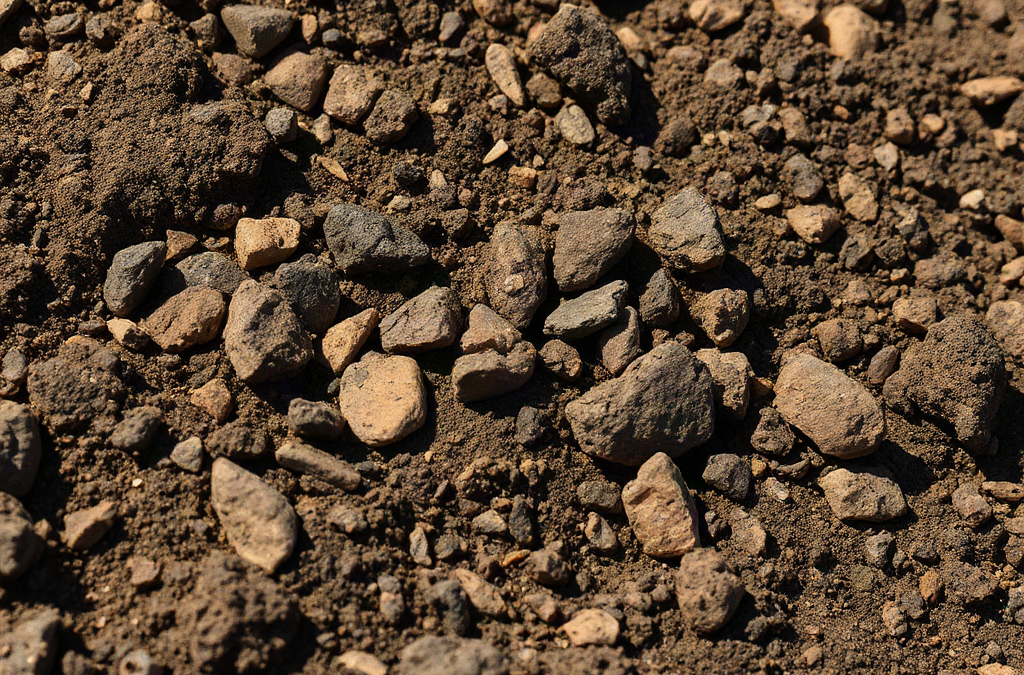
Soil types for gardening differ mainly in particle size, pore space, and organic matter, which determine whether water drains rapidly, remains available to roots, or displaces needed oxygen. Sandy soil drains quickly but dries and loses nutrients readily, while clay holds more moisture yet can remain saturated and compacted; silt and loam occupy the middle range. Test texture and drainage before amending a bed, then add compost to improve aggregation rather than trying to replace the soil’s mineral fraction. Match crops and watering frequency to existing conditions, and use raised beds or drainage work where prolonged saturation poses a greater risk than drought.
How Soil Texture Controls Drainage
Texture describes the relative amounts of sand, silt, and clay in mineral soil. Sand particles are comparatively large, silt particles are intermediate, and clay particles are extremely small. The spaces between those particles govern how quickly water enters the ground, how long it remains available, and whether roots receive enough oxygen. Large, connected pores move water readily; tiny pores retain it more tightly.
Particle size is only part of the behavior gardeners see. Soil structure—the way particles bind into crumbs or aggregates—can make two soils with similar textures perform differently. Clay with stable aggregates may accept water and support roots reasonably well. The same clay, repeatedly worked while wet or compressed by foot traffic, may become dense and nearly airless. Organic matter, roots, soil organisms, compaction, bed slope, and the depth of the underlying layers all influence the final result.
Drainage therefore has two useful meanings. Surface infiltration is the rate at which water enters the topsoil. Internal drainage is the movement of that water through the root zone and into deeper layers. A crusted surface may shed water even when the subsoil is relatively permeable. Conversely, water may enter a cultivated top layer quickly and then stop above compacted clay, creating a temporary perched zone around roots.
A common mistake is to treat the fastest-draining ground as the best ground. Roots need both water and oxygen. Excessively rapid drainage leaves plants dependent on frequent irrigation and allows soluble nutrients to move below shallow roots. Slow drainage creates the opposite pressure: oxygen becomes scarce, root growth slows, and some plants become more vulnerable to decay. Productive soil usually balances movement with storage rather than maximizing either one.
Depth also changes the interpretation. A few inches of dark, crumbly topsoil cannot compensate for a dense layer immediately below it. Before selecting amendments or crops, inspect at least the expected rooting depth and note whether texture changes sharply. The broader principles in soil types for gardening and their drainage tradeoffs are most useful when texture, structure, and soil profile are evaluated together.
Drainage Tradeoffs of Sandy, Clay, Silty, and Loamy Soil
Sandy soil favors rapid infiltration, early spring workability, and strong aeration, but its limited water and nutrient storage can make summer management demanding. A vegetable bed containing mostly coarse sand may look dry soon after irrigation, especially during hot or windy weather. Carrots and other root crops often appreciate the low physical resistance, yet leafy crops may require closer moisture monitoring and split nutrient applications rather than one heavy feeding.
Clay soil provides greater water and nutrient retention, but the usable growing window is narrower. It becomes sticky when too wet and hard when excessively dry. Digging or tilling wet clay can smear pore surfaces and create clods that persist after the bed dries. Plants tolerant of steady moisture may perform well where structure is intact, while Mediterranean herbs and bulbs prone to rotting are poor choices for a persistently saturated location. Clay should not automatically be labeled infertile; its main limitation is often physical access to air and roots rather than a lack of mineral-holding capacity.
Silty soil feels smooth and generally stores more water than sand while draining more readily than dense clay. Its fine particles are vulnerable to crusting and erosion when left bare. Heavy rain can seal the surface, reducing infiltration even though the soil below is not inherently impermeable. Mulch, living roots, and minimal disturbance help protect the surface. Silty beds can be productive, but walking on them while wet quickly reduces their favorable pore structure.
Loam contains a useful balance of particle sizes, although the name does not guarantee perfect drainage. Sandy loam, silt loam, and clay loam behave differently, and any of them can be compacted or underlain by a restrictive layer. A loamy topsoil placed over dense subsoil may drain poorly after prolonged rain. Likewise, a sandy loam may need more irrigation than the word “loam” suggests.
Organic soils and manufactured raised-bed mixes require separate judgment. Peat-rich or compost-heavy material may hold substantial water while still containing air when its structure is sound. Once allowed to dry severely, some ingredients can become difficult to rewet. Conversely, immature or very fine compost can settle and restrict air movement. Plant labels that request “well-drained soil” are not calling for sand alone; they indicate a root zone that releases surplus water while retaining enough moisture between waterings.
Simple Tests for Identifying Soil and Drainage Problems
Field observations provide better planting guidance than guessing from soil color or a single handful. Color can reflect organic matter, minerals, and drainage history, but it does not identify texture by itself. Begin when the ground is moist rather than saturated. Rub a small sample between your fingers: gritty material suggests abundant sand, floury smoothness suggests silt, and a sticky sample that forms a long ribbon indicates more clay.
A jar test can give a rough visual comparison of particle sizes. Remove stones and plant debris, place soil in a straight-sided transparent jar, add water, shake thoroughly, and let the material settle. Coarse sand falls first, followed by silt and then the finest clay. Organic debris may float. The layers are approximate because aggregated clay may not fully disperse, so the test is better for broad classification than precise percentages. A laboratory soil test is more appropriate when pH and nutrient recommendations are also needed.
Use a drainage check to investigate water movement rather than texture. Dig a hole within the proposed root zone, fill it once to moisten dry surrounding ground, allow it to drain, and fill it again. Observe whether the water level falls steadily and whether water remains into the following day. Exact rates vary with hole dimensions, initial moisture, and local soil, so avoid treating one home test as a laboratory measurement. Compare several spots instead, especially high and low parts of the bed.
A compact site checklist keeps the diagnosis focused:
- After rain: note puddles, runoff paths, and how long the surface stays glossy or soft.
- Below the surface: look for dense plates, abrupt texture changes, gray mottling, or roots that turn sideways.
- During irrigation: check whether water soaks in, runs off, or disappears without wetting soil several inches deep.
- During growth: compare wilting, yellowing, shallow roots, and uneven vigor across the bed.
Temporary puddling after an intense storm does not necessarily indicate chronically poor drainage. Repeated saturation after moderate rain is more concerning. On sandy ground, failure appears differently: the surface may accept water immediately while the root zone dries within a short interval. Dig after watering to see how deeply moisture actually traveled. That simple check prevents two opposing errors—watering clay again because the surface looks dry and giving sand a light sprinkle that never wets the full root zone.
Amendment and Planting Decisions That Fit the Site
Organic matter is the most broadly useful amendment because it improves aggregation in fine soil and increases moisture retention in coarse soil. Finished compost does not transform clay into loam or sand into loam; the mineral texture remains largely unchanged. Instead, repeated modest additions can create a more workable surface layer, support biological activity, and improve the arrangement of pores. Incorporate compost when establishing a bed, then maintain the surface with compost or organic mulch rather than repeatedly cultivating deeply.
Adding a small amount of sand to clay is a frequent failure. Unless sand is incorporated in a suitably large, well-designed proportion, the mixture can become dense and difficult to manage. Compost is generally the safer home-garden amendment. Gypsum is also not a universal clay cure; its value depends on the soil’s chemistry and should not be assumed without a soil test or locally appropriate guidance.
Match irrigation to the storage tradeoff. Sandy beds usually respond better to deeper watering at shorter intervals, with mulch reducing evaporation. Clay needs longer pauses so air can return to the root zone; watering by habit while the soil remains wet compounds the problem. Check moisture below the mulch with a finger, trowel, or probe. Improvement is visible when water enters without immediate runoff, the root zone remains evenly moist rather than saturated, and roots extend beyond the planting hole.
Severe drainage constraints call for design changes rather than endless amendment. A raised bed can lift roots above a seasonally wet layer, but it needs enough depth and an open path for surplus water. Mounding individual plants may suit shrubs or perennial herbs. Where water flows toward a bed from a roof, paving, or slope, redirecting that source may accomplish more than altering the soil. Major grading or subsurface drainage work warrants attention to neighboring properties, buried utilities, and local requirements.
Plant selection is the lowest-disturbance option. Rosemary, lavender, and many drought-adapted species generally favor a fast-draining position. Moisture-tolerant plants are better candidates for low areas, although few common crops tolerate continuously stagnant water. In a mixed vegetable plot, place crops sensitive to wet roots on the highest section and reserve lower, moisture-retentive ground for plants that tolerate steadier moisture.
Evaluate amendments over seasons, not days. Soil may settle after installation, mulch decomposes, and traffic can reverse structural gains. Keep permanent paths off growing areas, avoid digging wet beds, and replenish organic material according to how quickly it breaks down. For related planning choices, consult soil types for gardening and their drainage tradeoffs before buying bulk amendments solely on the promise of “better drainage.”
Frequently Asked Questions
Which soil type has the best drainage for a garden?
Sandy soil drains fastest, but a well-structured loam usually offers a better balance of drainage, moisture storage, nutrient retention, and root aeration.
Can compost fix poorly drained clay soil?
Finished compost can improve surface aggregation and workability over time, but it cannot remove a restrictive subsoil, high water table, or incoming runoff. Severe wetness may require raised planting areas or site drainage work.
Should sand be mixed into clay to improve drainage?
Small additions of sand can produce a denser mixture rather than improving it. Home gardeners are generally better served by organic matter, reduced compaction, and raised beds where drainage remains unsuitable.
How can I tell whether plants are receiving too much or too little water?
Check beneath the surface before watering. Saturated soil, odor, soft roots, and persistent yellowing suggest excess moisture, while dry soil through the root zone, crisp foliage, and rapid wilting indicate insufficient water.
Does adding topsoil improve drainage?
Topsoil helps only when its texture and placement suit the site. A permeable layer over compacted clay may hold water at the boundary, so inspect the soil profile and blend transitions carefully when establishing a bed.
Conclusion
Successful soil management begins with observing where water enters, where it stops, and how long the root zone remains wet. Texture sets broad limits, but structure, compaction, slope, and underlying layers often explain the drainage gardeners actually experience. Test several locations, inspect below the surface, and select plants before committing to bulk amendments.
Use finished compost to build aggregation and moderate moisture behavior, not as a promise that mineral texture will change. Keep traffic out of wet beds, adapt irrigation to water-storage capacity, and reserve raised beds or site drainage changes for persistent saturation. Recheck the bed after heavy rain and during dry weather; those two conditions reveal whether the chosen approach is balancing air and moisture or merely replacing one drainage problem with another.


