
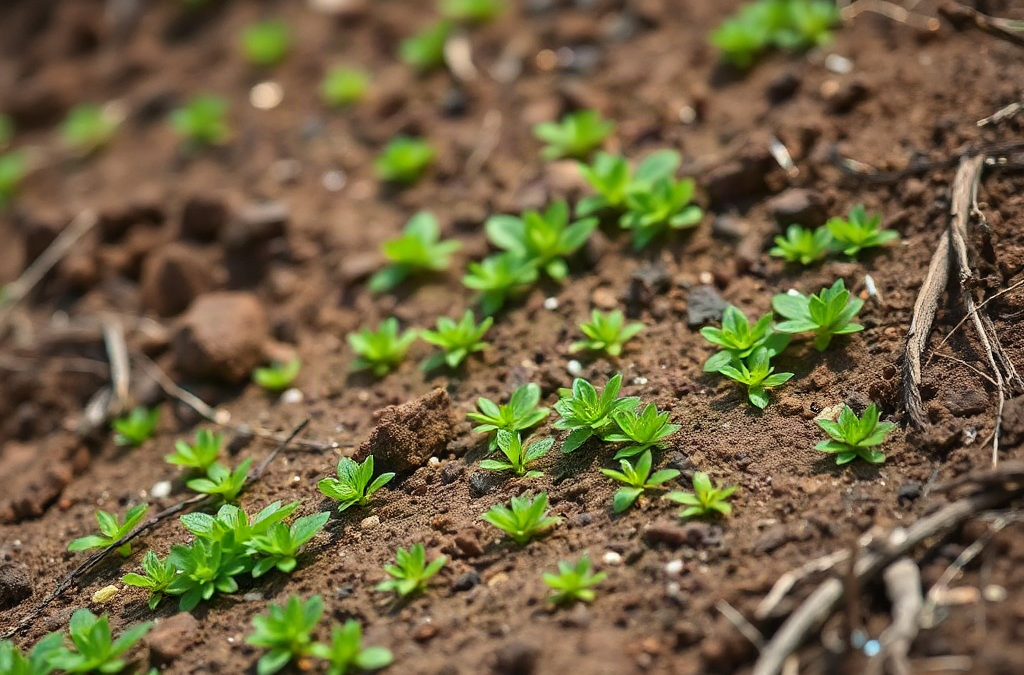
Fast ground cover for bare, erosion-prone soil works best as a three-stage system: protect the surface immediately, establish dense vegetation, and manage runoff until roots hold the slope. Cover exposed ground with erosion-control blanket or weed-free straw, then install suitable plugs, seed, or sod across the slope rather than in downhill rows. Match the vegetation to sunlight, moisture, climate, and foot traffic; fast spread alone does not guarantee effective erosion control. Redirect concentrated water before planting, keep the rooting zone evenly moist during establishment, and repair channels promptly if mulch shifts, seedlings wash out, or runoff remains muddy.
Stabilize the Surface Before Vegetation Fills In
Bare ground needs temporary protection from the first rainfall, because even vigorous ground cover takes time to produce enough leaves and roots to resist erosion. Raindrops break exposed aggregates apart, while runoff carries the loosened particles downhill. A steep grade, compacted subsoil, or water arriving from a roof, driveway, or neighboring slope accelerates that process. Covering the surface buys time for vegetation to establish; it does not replace the vegetation or correct concentrated drainage.
Begin by watching the site during rain if it is safe to do so. Sheet flow appears as a shallow film spread across a broad area and is often manageable with surface cover and dense planting. Small channels indicate that water is concentrating. A deeper groove, an actively undercut bank, or runoff threatening a foundation, road, utility, or neighboring property calls for drainage assessment before routine planting. Ground cover should not be expected to stabilize a failing retaining structure or carry a concentrated discharge safely.
For a modest residential slope, apply a biodegradable erosion-control blanket that remains in close contact with the ground. Secure it according to its product instructions, overlap sections in the direction that prevents runoff from getting beneath them, and avoid leaving tented areas. On gentle grades, a light layer of clean, weed-free straw may reduce splash and surface sealing. Loose bark nuggets and thick wood chips are less dependable on a pronounced incline because they can float, slide, or collect at the bottom. Fine shredded mulch interlocks better, but it must not bury seed or smother small crowns.
Surface preparation should be restrained. Aggressive tilling breaks the slope into easily transported particles and can create a slick boundary over compacted subsoil. Remove construction debris and persistent weeds, loosen only crusted areas that prevent rooting, and preserve stable soil wherever possible. If the ground is severely compacted, make shallow planting pockets or narrow contour-oriented bands rather than pulverizing the entire face. Compost may improve poor planting pockets, but a thick layer of loose compost left on top can wash away.
Use this immediate priority order:
- Stop concentrated inflow: Extend or redirect downspouts to an appropriate outlet and correct obvious sources of water above the slope.
- Protect exposed particles: Install a blanket, tackified fiber mulch, or another slope-rated cover that touches the surface.
- Plant through the protection: Create small openings rather than removing broad sections of the stabilizing material.
A common mistake is scattering seed over hard ground and assuming roots will develop before the next storm. Seed-to-soil contact, moisture, and protection from displacement all matter. The practical aim is not merely a green appearance; it is a protected surface with water moving slowly and no new sediment leaving the site.
Choose Ground Cover by Site Conditions
The best plant is one that forms lasting coverage under the site’s actual light, water, temperature, and use conditions. A species advertised as fast spreading may thin out in deep shade, fail in drought, become invasive locally, or offer little protection during its dormant season. Evaluate the planting zone rather than choosing from growth rate alone.
On sunny, mowable slopes, turf-type sod provides the quickest living cover when irrigation is available and the grade is safe to access. Sod has an immediate surface layer, but its shallow roots can dry before knitting into the underlying ground. It may also slump if laid on a steep face without suitable fastening. Seed costs less and covers larger areas economically, yet it leaves a longer vulnerable period and may produce uneven stands after heavy rain. Hydromulch can distribute seed and fiber over broad or awkward areas, but it is not a substitute for controlling runoff or selecting the correct seed mixture.
Low-growing perennial plugs are often more practical where mowing would be dangerous or undesirable. In sunny, relatively dry sites, locally suitable creeping perennials or low grasses may develop a woven root network once established. Shaded locations require species adapted to lower light and competition from trees. In regions where it is appropriate, sedges can be useful beneath open woodland canopies or in seasonally moist ground. Plants for consistently wet soil differ from plants that tolerate only occasional runoff, so inspect the area after rain rather than labeling every low spot “moist.”
Native species deserve consideration because well-matched regional plants can tolerate local weather and support habitat, but “native” does not automatically mean fast, evergreen, or suitable for every slope. Some spread slowly while investing in deeper roots; that can be an excellent long-term trait but requires stronger temporary erosion protection. Conversely, several aggressive vines and mat-forming plants sold as quick cover can escape into nearby beds or natural areas. Check regional invasive-plant guidance before installing any rapid spreader.
Foot traffic changes the decision. Delicate creeping plants will not stabilize a route repeatedly used by people or pets. Create stepping stones, a defined path, or reinforced access and plant around it. Near wildfire-prone structures, dense continuous vegetation may conflict with local defensible-space recommendations, so follow applicable fire-safety guidance rather than carpeting the entire area indiscriminately.
A sound Fast ground cover for bare erosion-prone soil choice balances establishment speed with mature behavior. Favor several compatible species or a professionally formulated regional mixture where uniform failure is a concern. The weak assumption to avoid is that a single fast runner will solve drainage, seasonal exposure, and site use at once.
Install Plants, Seed, or Sod for Continuous Coverage
Installation should interrupt downhill water movement while closing gaps as quickly as the selected material allows. Lay out plants in staggered rows across the contour, not in straight vertical lines that can become runoff lanes. Follow mature spacing for the species, then use temporary surface protection between young plants. Spacing plugs much farther apart to save money leaves the slope exposed longer and increases weeding, watering, and repair costs.
For plugs or small containers, prepare holes only slightly wider than the root mass and set each crown level with the surrounding surface. A sunken pocket collects sediment and may rot plants that dislike wet crowns; a high root ball dries rapidly and deflects water around itself. Firm the backfill enough to eliminate large air pockets without compressing it into a hard basin. Cut an X-shaped opening through erosion blanket where appropriate, place the plant, and close the material around the stem without covering the crown.
Seeded sites require an evenly prepared surface and close contact between seed and mineral earth. Choose a mixture and sowing season recommended for the local climate rather than using a universal package rate. Some cool-season grasses establish best during cooler periods, while warm-season species may need warmer ground. Broadcast passes in two directions for more even distribution, then lightly press the seed into the surface. Do not rake it deeply unless the specific seed requires burial. Protect the area with a seed-compatible blanket or properly applied fiber mulch.
Sod should be installed promptly after delivery because rolled turf heats and dries quickly. Lay pieces across the slope with staggered seams, press them against the prepared ground, and secure them where the grade or product guidance requires it. Gaps expose soil and concentrate drying, while overlapping edges prevent consistent root contact. Sod may look finished on day one, but it remains vulnerable until roots penetrate the underlying surface. Lift a corner gently after establishment begins; resistance is a better sign of rooting than green color alone.
Watering must moisten the rooting zone without generating runoff. Newly seeded surfaces may need light, frequent irrigation, whereas rooted plugs benefit from deeper wetting with some drying appropriate to the species. Cycle-and-soak irrigation—short applications separated by pauses—allows tight or sloping ground to absorb water. If water begins moving downhill, stop and let it infiltrate rather than completing a preset runtime.
A realistic example is a sunny bank below a lawn. Sod may be fastest if it can be watered reliably and mowed safely. If mowing is impractical, a blanket planted with regionally appropriate low perennials or grasses demands more patience but reduces future slope access. The common failure in both approaches is withdrawing water as soon as the surface turns green. New leaves can appear before roots occupy enough ground to withstand heat or intense rain.
Monitor Runoff and Correct Early Failures
Successful stabilization is measured after rain, not only by plant growth during dry weather. Clearer runoff, intact surface cover, expanding roots, and the absence of new channels indicate progress. Muddy water, exposed roots, displaced blanket, sediment at the slope toe, or repeated bare streaks show that soil is still moving. Inspect after irrigation and each substantial storm during establishment, then reduce the frequency once the cover is dense and stable.
Repair small problems while they remain small. Replace washed soil around exposed roots, resecure loose blanket, and reseed thin patches during a suitable establishment window. If the same strip repeatedly erodes, adding more seed will usually repeat the failure. Trace the water uphill. A downspout outlet, compacted path, irrigation overspray, or low edge may be directing flow toward that strip. Spread benign sheet flow where appropriate or convey concentrated water through a properly designed drainage route rather than forcing plants to absorb it.
Weed control also affects coverage. Pull or cut weeds before they seed, but avoid leaving large bare holes all at once. On a heavily infested slope, staged removal paired with immediate replanting protects more ground than clearing the entire area. Herbicide use, if chosen, must follow the label and account for nearby water, desirable vegetation, and local restrictions. Landscape fabric is rarely a complete slope solution: exposed fabric degrades, mulch slides from it, and openings can funnel water around plant crowns.
Seasonal dormancy deserves planning. A deciduous or warm-season cover may protect soil through roots and stems even when it is not green, but sparse winter structure can leave gaps vulnerable to intense seasonal rain. Combining persistent low vegetation with bunch-forming grasses or other compatible plants can provide more layered protection. Do not mix species that have sharply conflicting irrigation needs; keeping a drought-adapted cover constantly wet to support a thirsty companion weakens the planting design.
The maintenance threshold should be clear. Minor splash, a loosened staple, or one failed plug is routine. Widening gullies, bulging ground, exposed structural footings, leaning walls, or sudden seepage are not routine gardening problems. Pause planting and seek qualified drainage, geotechnical, or landscape help when movement threatens property or safety.
Keep a simple rain checklist tied to Fast ground cover for bare erosion-prone soil: inspect the upper water source, the planted face, and the slope toe; note where sediment collects; repair displaced protection; and adjust irrigation only after checking moisture below the surface. The mistake to avoid is judging success from foliage alone. Stable soil, rooted coverage, and controlled water must develop together.
Frequently Asked Questions
What is the fastest living cover for an erosion-prone slope?
Sod gives the quickest continuous living surface on a manageable sunny slope, but it needs firm soil contact, reliable watering, and safe maintenance access. Plugs or locally suitable seed may be better for steep, shaded, or unmowable areas.
Can mulch stop erosion before plants grow?
Mulch can reduce raindrop impact and slow shallow flow, but loose material may wash down steep ground. A secured erosion-control blanket is generally more dependable while roots establish, especially where runoff has already moved soil.
Should ground cover be planted in rows on a slope?
Use staggered rows running across the contour. Straight downhill rows can create channels between plants, while offset spacing interrupts flow and closes gaps more evenly as foliage expands.
Why does seed keep washing off the same area?
Repeated washout usually indicates concentrated water, poor seed contact, an unprotected surface, or unsuitable sowing timing. Find the uphill water source, protect the seed with a compatible blanket, and correct runoff before reseeding.
When does an eroding slope need professional help?
Seek qualified help for deep or widening gullies, ground movement, persistent seepage, failing walls, or erosion near buildings, roads, utilities, and property boundaries. Vegetation alone cannot correct structural instability or safely route major flows.
Conclusion
Begin with water movement rather than a plant catalog. Identify incoming runoff, protect exposed particles immediately, and then select vegetation that can remain dense under the site’s light, moisture, climate, and traffic. Sod offers rapid coverage where access and irrigation are practical; seed and plugs take longer but can suit larger, steeper, shaded, or unmowable areas when paired with temporary erosion protection.
Install across the contour, maintain soil contact, and water slowly enough to avoid runoff. After rain, look for sediment, channels, lifted blanket, exposed roots, and recurring bare strips instead of judging the project only by leaf growth. Prompt repairs keep minor losses from becoming gullies. If the ground is moving, drainage is concentrated, or nearby structures are at risk, treat the situation as a slope or drainage problem requiring qualified assessment rather than relying on faster-growing vegetation.


