
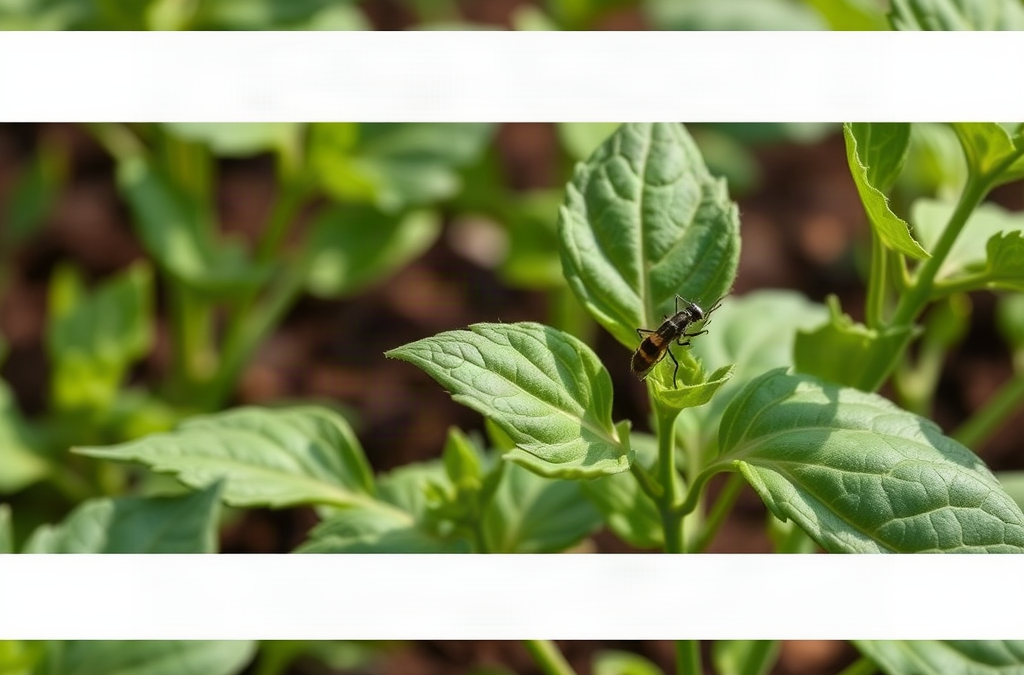
If vegetable plants are infested with pests, identify the insect and measure the damage before choosing a control, then remove heavily affected leaves, hand-pick visible pests, and protect beneficial insects while monitoring the crop daily. Check leaf undersides, stems, growing tips, and soil-level tissue for eggs, droppings, webbing, holes, or sap-feeding damage. Use barriers, water sprays, traps, or a pest-specific product only when physical controls are insufficient. Avoid spraying unidentified insects or treating flowers visited by pollinators. Follow the pesticide label exactly, including crop approval, application rate, protective equipment, reentry time, and preharvest interval.
Confirm Which Pest Is Damaging the Crop
Accurate identification determines whether intervention will protect the crop or kill harmless and beneficial insects. Begin by inspecting several plants, including apparently healthy ones at the edge of the affected area. Look beneath leaves, along veins, inside curled foliage, around growing tips, and where stems meet the soil. Record the insect’s size, color, shape, movement, and location rather than relying on plant damage alone.
Different feeding patterns narrow the possibilities. Aphids often cluster on tender shoots and produce sticky honeydew. Flea beetles leave numerous small, rounded holes, especially on young brassicas and eggplants. Caterpillars create irregular chewing damage and may leave dark droppings nearby. Spider mites cause fine stippling or bronzing and may produce delicate webbing, although they are arachnids rather than insects. Cutworms usually sever seedlings close to ground level and hide in the upper soil during daylight.
Damage does not prove that an insect currently present caused it. A lady beetle beside an aphid colony is likely feeding on the infestation, while a wasp visiting a caterpillar may be a predator or parasitoid. Old holes can remain after the responsible pest has departed. Before treating, place a sheet of white paper beneath foliage and tap the plant gently; small insects that fall onto the paper are easier to examine. A hand lens and clear photographs also make comparison with university extension identification pages more reliable.
Decide whether the crop can tolerate the current injury. A mature tomato plant may continue producing despite a few chewed leaves, whereas flea beetles can seriously weaken newly emerged seedlings. Damage to the harvested portion deserves closer attention: caterpillars entering broccoli heads or fruit-boring larvae are harder to remove later than insects feeding on expendable outer foliage. Rapidly expanding damage, distorted new growth, and declining plant vigor justify faster action than stable cosmetic injury.
A common failure is assuming every visible insect requires a broad treatment. That response can remove predators while leaving concealed eggs or larvae untouched, allowing the pest population to rebound. Gardeners deciding what to do if your vegetable plants are infested with pests should first match the insect, life stage, and feeding evidence. If identification remains uncertain, take clear images or a sealed specimen to a local cooperative extension office rather than applying products by trial and error.
Contain the Infestation Without Harming the Garden
Physical removal is often the safest first response to a localized infestation. Hand-pick hornworms, beetles, caterpillars, egg masses, and squash bug nymphs, dropping them into soapy water if appropriate. Prune leaves carrying dense aphid colonies or leaf-miner damage, but retain enough healthy foliage for photosynthesis. Infested material should leave the growing area; placing it beside the bed gives mobile pests an easy route back.
A firm stream of water can dislodge aphids and mites from sturdy plants, particularly when directed at leaf undersides early enough for foliage to dry. This method is less suitable for fragile seedlings, plants with fungal disease concerns, or insects that quickly climb back from the soil. Repeat inspections are necessary because water does not reliably remove every egg. For low-growing crops, gently lifting leaves during treatment prevents the spray from merely moving pests to another part of the canopy.
Barriers work best before or at the beginning of an outbreak. Insect netting or lightweight row cover can exclude flea beetles, cabbage moths, and other flying pests, provided the edges are sealed and no adults or eggs are trapped underneath. Remove or open covers when insect-pollinated crops such as squash and cucumbers flower, unless flowers are hand-pollinated. Brassicas grown for leaves or heads can often remain covered longer because pollinator access is not required for the edible crop.
Use a short containment checklist before considering a pesticide:
- Mark the affected area: Determine whether damage is limited to one plant, one crop row, or the entire bed.
- Remove reachable pests and eggs: Inspect both surfaces of leaves and nearby supports.
- Separate movable plants: Isolate infested container vegetables from uninjured pots.
- Clear hiding places selectively: Remove crop debris touching stems without stripping all habitat used by beneficial insects.
- Recheck within one or two days: Compare fresh injury with the original damage rather than counting old holes.
Do not compensate for pest injury with excessive fertilizer or water. High-nitrogen feeding can produce soft, lush growth attractive to aphids, while saturated soil adds root stress to already weakened plants. Removing too much foliage is another costly reaction; a plant stripped to eliminate a small colony may lose more productive capacity from pruning than from the pest. Containment is working when new leaves remain intact, pest counts decline, and damage stops spreading to neighboring plants.
Choose a Control That Matches the Pest
A treatment should target the identified pest at a vulnerable life stage while exposing as few other organisms as possible. Insecticidal soap can contact and control soft-bodied pests such as aphids, whitefly nymphs, and some mites, but it has little residual action and must reach the insect directly. Horticultural oils also depend on thorough contact and can affect eggs or small, exposed pests. Both may damage foliage under unsuitable temperatures or when used on sensitive plants, so the product label and a small test application matter.
Bacillus thuringiensis var. kurstaki, commonly listed as Btk, is useful for susceptible caterpillars that consume treated foliage. It does not serve as a general beetle, aphid, or squash bug control, and larger caterpillars may be harder to suppress than young larvae. Spinosad products may control certain chewing insects, but formulations and approved uses differ. They can also harm bees when wet, making label restrictions and application timing critical. A product being described as natural or organic does not make it harmless to pollinators, aquatic organisms, skin, or eyes.
Neem-based products vary in their active ingredients and label directions. They should not be treated as universal remedies, especially when the pest is concealed inside a stem, fruit, or leaf mine. Contact sprays rarely reach borers after they enter plant tissue. In that situation, removing affected stems or plants, protecting the next planting, and disrupting the pest’s life cycle may be more realistic than repeatedly coating the crop.
Read the entire label before purchase, not just before spraying. Confirm that both the vegetable crop and target pest appear on the label. Check the application rate, maximum number of treatments, required protective equipment, environmental warnings, reentry directions, and preharvest interval—the time that must pass between application and harvest. Never assume a product approved for ornamental plants can be used on edible crops, and do not increase concentration to compensate for poor results.
Application quality affects both control and risk. Treat the specific plants and surfaces where the pest feeds rather than spraying the whole garden automatically. Avoid open flowers and periods when bees are active. Wind can carry droplets onto herbs, neighboring crops, ponds, or play areas, while rain soon after treatment may reduce effectiveness depending on the label. Mixing multiple products without explicit label authorization can injure plants or create unnecessary exposure.
The strongest approach to what to do if your vegetable plants are infested with pests is escalation: tolerate minor injury, use physical measures for small colonies, and reserve labeled products for active damage that continues. Broad-spectrum treatment may produce a quick reduction, but it can also kill predators that provide longer-term suppression. If repeated, correctly applied treatments fail, reconsider the identification and coverage instead of increasing the dose.
Monitor Recovery and Prevent Another Outbreak
Plant recovery is measured by new growth and slowing damage, not by the disappearance of old scars. Mark the edge of a damaged area with a non-toxic pen or photograph the same leaves each day. New holes, fresh droppings, recently curled shoots, or increasing sticky residue indicate continuing activity. Old leaves will not repair themselves, so waiting for blemishes to vanish creates the false impression that a successful control has failed.
Inspect affected plants every day during an active outbreak, then reduce the frequency as pest numbers decline. Include nearby weeds, crop residues, stakes, leaf litter, and the undersides of adjacent plants. Some pests move between plant families, while others are tightly associated with a particular crop. Yellow sticky cards can help reveal flying aphids or whiteflies in protected growing spaces, but they are monitoring tools rather than complete controls and may catch non-target insects outdoors.
Prevention should address the route that allowed the infestation to build. Rotate crop families where space permits, remove finished plants promptly, and avoid leaving heavily infested residue beside the next planting. Rotation has limits in small gardens because mobile insects can fly across beds, but it is more useful against pests that overwinter in soil or crop debris. Healthy soil and steady irrigation improve a plant’s ability to tolerate modest leaf loss, yet vigorous growth does not make a susceptible crop pest-proof.
Timing can reduce future exposure. A gardener who repeatedly loses young kale to flea beetles might use insect netting immediately after planting rather than waiting for holes. Squash growers who encounter squash bugs can inspect leaf undersides for bronze-colored egg clusters during the earliest part of the season. Staggered planting can preserve some harvest if one planting meets peak pest pressure, although successive crops may also provide pests with a continuous food source. The local pest cycle should guide that choice.
Encourage predators by maintaining flowering plants that provide nectar and by limiting unnecessary insecticide use. Hoverfly larvae, lacewing larvae, lady beetles, predatory bugs, and parasitoid wasps may reduce exposed pests, but they rarely produce an instantly spotless crop. Buying and releasing beneficial insects outdoors can be disappointing if they disperse or if the habitat cannot support them. Conserving predators already present is generally more practical than expecting purchased insects to correct a severe outbreak.
Remove a plant when it is collapsing, heavily infested with a pest that cannot be reached, or serving as a reservoir that threatens more valuable crops. Keeping a badly damaged plant is not always economical, particularly late in its productive season. Conversely, discarding a vigorous plant over a few cosmetic holes wastes established roots and future harvest. Continued monitoring helps distinguish tolerable feeding from a renewed increase requiring action.
Frequently Asked Questions
Should I remove every pest-damaged leaf?
No. Remove leaves carrying concentrated pests, eggs, or extensive damage, but preserve enough healthy foliage to support growth. Minor holes on older leaves usually do not justify heavy pruning.
Can I eat vegetables from an infested plant?
Produce with superficial insect damage may often be washed and trimmed, but discard rotten, contaminated, or severely tunneled portions. If a pesticide was applied, obey its crop approval and preharvest interval.
Will dish soap safely kill vegetable pests?
Household dish detergents are not interchangeable with labeled insecticidal soaps and may burn foliage. Use a product labeled for the crop and pest, following its dilution and application directions.
When should a badly infested vegetable plant be discarded?
Remove it when it is unlikely to recover, contains unreachable borers, or continually supplies pests to healthier crops. Bagging may be appropriate if loose transport would spread insects.
How soon should pest treatment show results?
Timing depends on the pest and method. Contact controls may reduce exposed insects quickly, while barriers and biological controls work more gradually. Judge progress by fewer pests and less new damage.
Conclusion
Successful pest control begins with evidence: identify the organism, locate its life stage, and determine whether fresh damage is increasing. A small, exposed colony often responds to hand removal, pruning, water, or a barrier without disrupting predators. Persistent infestations may justify a crop-labeled control, but only when its target, application conditions, pollinator precautions, and harvest restrictions match the situation.
Photograph the affected foliage today, inspect neighboring plants, and remove reachable pests or eggs. Recheck new growth within the next few days rather than judging scarred leaves. If injury continues, confirm the identification through a cooperative extension resource before escalating treatment. That measured sequence protects the harvest while avoiding the common mistake of creating a second problem through unnecessary spraying, excessive pruning, or improper product use.


