
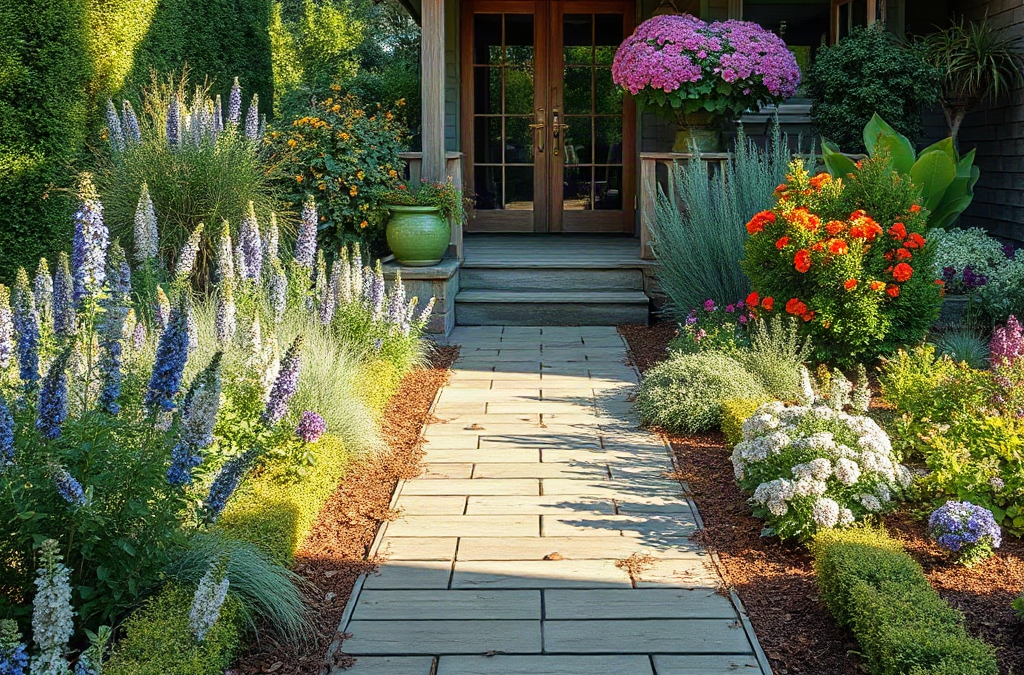
Choose shrubs that stay low near pathways by matching their mature height and spread to the available bed width, rather than relying on nursery size or frequent pruning. Favor compact cultivars with naturally dense growth, non-thorny branches, and roots unlikely to heave nearby paving. Check sunlight, drainage, winter exposure, and whether snow, foot traffic, or opening car doors will press against the shrub. Leave enough clearance for branches to mature without narrowing the walking surface.
How Much Pathway Clearance Do Shrubs Need?
Available width should be measured from the shrub’s intended center to the usable edge of the path, not merely to the border of the bed. Branches extending over paving reduce shoulder room, hold rainwater against clothing, obscure edging, and can make two people pass single file. Along a driveway or parking area, the same encroachment can interfere with doors and sightlines.
Begin by measuring the bed at its narrowest point. If a bed provides 30 inches between a wall and a walkway, a shrub advertised as spreading 36 inches is already too broad unless its center can be positioned elsewhere. Planting it against the wall does not create more room; it usually produces a flattened back, a path-facing canopy, and repeated shearing. A narrower cultivar or a low perennial mass would fit the site more honestly.
Published dimensions are estimates rather than stopping points. Climate, growing season, irrigation, soil fertility, and plant age can all influence final size. Mature spread is especially easy to underestimate because a small container-grown shrub may take several years to reveal its normal outline. Treat the listed width as a minimum planning figure and provide extra space where pedestrian clearance is critical.
Placement must account for how the path is used. A private stepping-stone route tolerates slightly softer edges than a front walk used by visitors, delivery workers, or mobility devices. Steps, bends, gates, and intersections require particularly clear margins because people shift direction there. Snow storage also matters in cold climates: a shrub placed close to the pavement may be crushed by shoveled snow or exposed to deicing salts.
A practical layout test is to mark each shrub’s projected diameter on the ground with a hose, string, or landscape paint. Then walk the route while carrying bags, pushing a mower, or opening adjacent gates. If the marked canopy occupies space needed for movement, change the plant or its location before digging. The common failure is assuming annual pruning will recover space that the design never provided.
Which Growth Habits Work Beside Walkways?
Naturally compact growth is more dependable beside a walkway than a vigorous shrub kept short by shearing. A low, mounded form generally holds its foliage close to the framework, while arching or fountain-shaped branches may extend far beyond the plant’s measured base. Two shrubs with the same stated height can therefore behave very differently at ankle, knee, and shoulder level.
Read cultivar descriptions carefully. The species name alone may encompass upright, spreading, dwarf, and full-sized forms. A named compact cultivar can be appropriate, but the word “dwarf” is relative: it may mean half the size of a very large species and still become too wide for a narrow border. Verify both dimensions from more than a decorative plant tag when possible, using regional extension material, botanical garden records, or reputable nursery references.
Low selections may include compact forms of boxwood, Japanese holly, inkberry, spirea, potentilla, dwarf conifers, or small-leaved rhododendrons, depending on regional climate and site conditions. These are categories to investigate rather than universal recommendations. Boxwood may struggle where disease pressure is high; Japanese holly requires suitable soil and climate; inkberry can become bare at the base without enough light; and many dwarf conifers expand slowly but continuously for decades.
Branch texture changes how a shrub interacts with people. Fine, flexible stems usually brush past more comfortably than stiff, pointed, or thorn-bearing growth. Avoid barberry, pyracantha, roses, and other armed shrubs where bare legs, pets, children, or maintenance workers regularly pass. Even an attractive flowering shrub becomes a poor pathway choice when its long shoots must be tied back or cut repeatedly during the growing season.
Deciduous and evergreen forms present another tradeoff. Evergreens define an edge throughout winter and may hide bare ground, but snow load can splay some varieties into the route. Deciduous shrubs allow winter light and often provide flowers, yet fallen leaves or seed heads may need cleanup from smooth paving. Select the growth habit that works during the shrub’s least convenient season, not only when it looks best at the nursery.
Match Shrubs to Light, Soil, and Exposure
A size-compatible shrub will not remain compact and attractive if the site prevents balanced growth. Plants leaning toward available light often send their longest branches over a path, while shrubs stressed by saturated ground may thin out, decline, or require replacement. Record direct sun, shade duration, drainage, wind, and reflected heat before narrowing the selection.
Observe the location at several points during the day. A bed described casually as “part shade” may receive intense afternoon sun reflected from pale paving or a south-facing wall. Conversely, a shrub beneath an overhang may receive little rainfall even though the surrounding yard is moist. Reflected heat increases water loss, while roof runoff can periodically flood another part of the same bed. These small-scale differences often explain why identical shrubs grow unevenly along one route.
Drainage can be checked after substantial rain or by examining how long a test hole remains wet after watering. The goal is not to assign a technical soil label from one observation, but to identify persistent saturation or unusually rapid drying. If water collects beside the walkway because compacted subsoil blocks drainage, choosing a moisture-tolerant shrub may be more realistic than expecting a dry-site species to adapt. Where paving directs runoff into the bed, correct the grade or drainage problem before planting if feasible.
Cold exposure and road salt deserve separate attention. Shrubs near driveways can receive salty splash, contaminated snow, or abrasive piles from plowing. A plant hardy to the region may still suffer in that exact position because winter wind and deicing residue intensify stress. Moving the shrub farther back, creating a snow-storage gap, or using a more tolerant planting may outperform protective pruning after damage occurs.
Do not improve a small planting hole with a pocket of rich material while leaving dense surrounding ground untouched. Roots eventually encounter the native soil, and abrupt changes in texture can affect water movement. Prepare the bed according to actual site conditions, set the root flare correctly, and mulch without burying stems. Success is visible in even growth directed around the whole plant; repeated leaning, bare interior branches, scorched margins, or standing water indicate that the site and selection are mismatched.
Evaluate Roots, Litter, Thorns, and Maintenance
Pathway suitability includes what happens below the canopy and throughout the year. Most genuinely small shrubs are less likely than large woody plants to disrupt paving, but no plant should be judged by height alone. A shrub capable of becoming broad and woody may exert pressure at an edge, while roots exploiting cracks or consistently moist joints can complicate repairs.
Existing pavement condition matters. Sound concrete or well-installed pavers are less vulnerable than loose edging laid over shallow, compacted material. Keep woody crowns away from joints and avoid positioning shrubs where excavation for future path repairs would destroy their main roots. If the route contains utility access, drainage components, or lighting cable, preserve service space rather than concealing it with permanent woody growth.
Seasonal debris also changes maintenance demands. Flower petals can become slippery when mashed onto smooth surfaces, berries may stain, and seed capsules can roll underfoot or lodge between pavers. Leaf drop is usually manageable on a lightly used path, but a shrub that sheds repeatedly over an entrance walk creates a different burden. Consider whether debris can be swept easily and whether fruit will attract feeding activity directly beside a doorway.
Pruning should refine the plant rather than control its basic dimensions. Selective thinning or shortening at appropriate branch junctions preserves a natural outline better than repeatedly shearing the outer shell. Shearing often creates dense surface growth and a bare interior; when the shrub must In summary be reduced, cutting into old leafless wood may leave conspicuous gaps. Flowering can also be reduced when pruning removes buds formed on older stems.
Budget calculations should include labor after installation. A slightly more expensive compact cultivar may cost less over time than a fast-growing substitute trimmed several times each season. Watch for shoots entering the walking zone, branches rubbing walls, persistent bare patches, and a canopy that expands beyond its planned outline. Those signs show that maintenance is compensating for selection or spacing errors rather than simply caring for the shrub.
Pathway Shrub Selection Checklist
A short selection process prevents attractive nursery specimens from becoming permanent clearance problems. Complete the measurements and site observations before comparing flower color or foliage. Appearance still matters, but it should distinguish among shrubs that already satisfy the physical limits of the location.
- Measure usable space. Record bed depth, path width, nearby walls, steps, doors, and the room required for normal passage.
- Confirm mature dimensions. Check the expected height and spread of the exact cultivar, then allow a margin for regional vigor and plant age.
- Inspect the growth habit. Prefer dense, compact, or gently mounded branching over thorny, strongly arching, suckering, or sprawling growth.
- Match the exposure. Compare the shrub’s needs with actual sunlight, drainage, reflected heat, wind, rainfall coverage, and winter salt exposure.
- Estimate maintenance. Account for pruning frequency, leaf or fruit cleanup, irrigation during establishment, and access to the path edge.
- Test the layout. Mark the mature footprint and walk through the space before purchasing or digging.
When two candidates fit, favor the one whose natural shape most closely matches the available volume. For example, a 24-inch rounded shrub is usually a better choice for a shallow rectangular bed than a 24-inch-tall shrub with a 48-inch arching spread. Height alone does not describe the conflict that pedestrians will encounter.
Be willing to reject shrubs entirely where the bed is too narrow. Low groundcovers, clumping perennials, sedges, or a wider strip of paving may be safer and easier to maintain. The sign of a sound decision is not that a woody plant has been fitted into every opening; it is that the completed route remains clear after several seasons without harsh, frequent cutting.
Frequently Asked Questions
How far should a low shrub be planted from a walkway?
Use half of the shrub’s expected mature spread as a starting distance from its center to the path edge, then add clearance for arching branches, snow, or heavy foot traffic.
Can any shrub be kept small through pruning?
No. Repeatedly restricting a vigorous shrub creates dense outer growth, bare interiors, frequent labor, and possible loss of flowers. A naturally compact cultivar is usually more reliable.
Are dwarf shrubs always suitable beside paths?
No. “Dwarf” only means smaller than the typical form. Check the exact mature height, spread, branching pattern, and regional performance before buying.
Which shrub features should be avoided near a busy walkway?
Avoid thorns, rigid projecting branches, messy or staining fruit, aggressive suckering, and growth that must be tied back or sheared repeatedly to preserve passage.
What can replace shrubs in a very narrow pathway bed?
Consider compact clumping perennials, sedges, restrained groundcovers, or additional paving. Choose a replacement suited to the light, moisture, traffic, and required edge definition.
Conclusion
Measure the usable planting volume before choosing a shrub, and treat mature spread as seriously as mature height. The strongest candidates fit without depending on constant shearing, have branches that will not scratch passersby, and tolerate the bed’s actual light, drainage, heat, wind, and winter exposure. Check debris, thorns, root conflicts, and access for pavement maintenance before making appearance the deciding factor.
Mark each projected footprint on the ground and test the route under normal use. If the outline reaches into needed walking space, choose a narrower cultivar, move the planting center, or use a non-woody alternative. That early adjustment is easier than correcting a crowded shrub after its permanent framework has developed.
For regional shrub dimensions and site tolerances, consult your local university cooperative extension service, a nearby botanical garden’s plant database, and the USDA Plants Database. Local sources are especially useful because mature size, winter damage, disease pressure, and heat tolerance vary by climate.


