
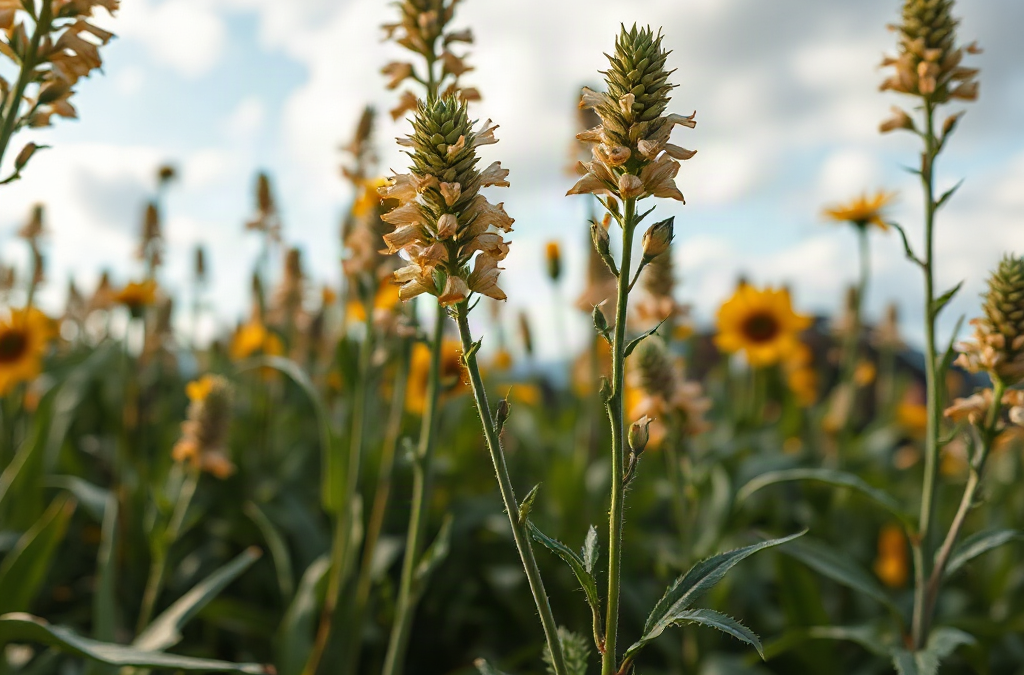
Tall plants that resist collapse in garden wind combine rigid or flexible stems, modest leaf area, deep root systems, and growth suited to the site’s light and moisture. Upright grasses such as switchgrass and feather reed grass shed wind through narrow foliage, while baptisia, ironweed, and Culver’s root build self-supporting frameworks when grown in full sun without excess fertilizer. Plant exposure still matters: saturated soil weakens anchorage, shade encourages leaning, and rich nitrogen-heavy ground produces soft growth. No tall plant is storm-proof, but correct spacing, restrained feeding, early-season pruning where appropriate, and sheltered placement greatly reduce lodging.
What Makes a Tall Plant Wind-Resistant?
Wind resistance comes from the whole plant structure rather than height alone. Strong candidates either bend without breaking or hold themselves upright through firm stems and a broad root crown. Narrow leaves, open branching, and seed heads that allow air to pass through create less drag than broad foliage packed into a dense canopy. A six-foot grass can consequently remain standing while a shorter perennial with soft stems and large leaves folds after a storm.
Stem construction explains much of that difference. Ornamental grasses distribute force through numerous flexible culms arising from a dense crown. Sturdy broadleaf perennials such as baptisia develop branching stems that become increasingly firm as they mature. Plants with hollow, weak, or unusually lush stems may lodge at the base, especially when heavy flowers collect rainwater. Wind resistance should therefore be judged by stem behavior and canopy shape, not by a catalog description such as “upright.”
Roots provide the second part of the support system. Clump-forming prairie plants generally develop substantial crowns and extensive roots after establishment. They may move visibly in a gust while remaining anchored. Recently planted specimens do not yet have that advantage, so even a naturally resilient species may need discreet temporary support during its first growing season. Loose root balls, poorly firmed planting holes, and continuously saturated ground allow the entire crown to rock, damaging new roots and reducing future stability.
Growing conditions can override a plant’s natural architecture. Too much nitrogen produces long, soft extension growth, while insufficient sunlight makes stems stretch toward the brightest opening. Crowding has a similar effect: lower leaves receive less light, stems become thin, and neighboring plants provide temporary support until rain or wind pushes the group apart. The common mistake is to stake the resulting weak growth year after year rather than correct shade, fertility, or spacing.
A useful wind-resistant plant should meet most of these checks:
- Stem response: firm or springy rather than brittle and soft.
- Canopy: narrow foliage or open branching that does not act like a sail.
- Base: a dense crown or well-branched framework with no persistent rocking.
- Site fit: enough light and drainage to produce compact, mature growth.
No living stem is immune to severe thunderstorms, falling branches, or exceptionally exposed coastal conditions. The practical goal is a planting that normally recovers its shape after routine gusts and rain without requiring conspicuous stakes.
Which Upright Plants Are Reliable on Windy Sites?
Clump-forming grasses are usually the most dependable starting point because their narrow blades release wind pressure and their many stems share the load. Feather reed grass, especially the widely grown cultivar ‘Karl Foerster,’ forms a narrow vertical clump with early flower stalks. Switchgrass cultivars offer a looser silhouette and often retain their structure into winter. Little bluestem is shorter but useful where a three- to four-foot layer is sufficient. Select clumping forms rather than running grasses unless spreading is specifically wanted.
Several broadleaf perennials also develop durable frameworks. Baptisia forms a shrub-like mound once established and generally needs no staking in full sun and ordinary soil. Culver’s root sends up tall, slender flower spikes above whorled foliage, while ironweed combines rigid stems with late-season purple flowers. Rattlesnake master has branched stems, narrow leaves, and rounded flower heads that expose relatively little surface area to gusts. These plants are not interchangeable: ironweed tolerates more moisture than rattlesnake master, while baptisia dislikes frequent disturbance after its substantial root system develops.
| Plant | Typical Mature Height | Useful Site | Main Limitation |
|---|---|---|---|
| Feather reed grass ‘Karl Foerster’ | About 4–6 feet in flower | Sunny, moderately moist beds | Declines in deep shade or persistently wet ground |
| Switchgrass | About 3–6 feet, depending on cultivar | Sunny borders and open exposures | Some cultivars relax outward more than others |
| Baptisia | About 3–5 feet | Sunny, well-drained perennial beds | Slow to develop its mature framework |
| Culver’s root | About 4–7 feet | Sunny soil with consistent moisture | May lean if shaded or allowed to dry severely |
| Ironweed | About 4–7 feet | Sunny sites with average to moist soil | Can be too vigorous or tall for a small border |
Regional suitability matters more than assembling a universal list. Winter hardiness, summer humidity, rainfall, and local soil influence whether a plant makes a compact clump or weak growth. A locally suitable native species or regionally tested cultivar is often a safer investment than an unfamiliar plant selected only from a photograph. Check mature height as well as spread, because a tall plant forced into a narrow gap may lean over nearby paths even when its stems have not technically collapsed.
A frequent selection error is choosing top-heavy flowers for the most exposed position. Large double blooms and broad leaves catch both rain and wind. Place those plants behind a wind-filtering layer or accept early support; reserve the open edge of the bed for grasses and self-supporting perennials with smaller flower heads.
How Should Plants Be Matched to Exposure and Soil?
Site matching begins by observing where wind enters, accelerates, and swirls. A broad open lawn delivers steady exposure, while a gap between buildings can funnel gusts into a narrow strip. Corners and solid fences create turbulence on their sheltered side rather than stopping air cleanly. A plant that stands well in an open border may bend repeatedly when placed in one of these concentrated wind paths.
Use a permeable wind filter when the exposure is extreme. A mixed shrub border, open fence, or layered planting slows air without producing the abrupt eddies associated with a solid barrier. The aim is not to seal off the garden but to reduce peak force before it reaches tall stems. Place resilient grasses or woody plants on the windward edge and more top-heavy flowering perennials farther inside. Leave enough clearance for air circulation; packing plants tightly trades wind movement for shade-induced weakness.
Drainage deserves equal attention. Roots anchor poorly in soil that remains waterlogged, and a saturated root zone may let a large crown pivot during a gust. Conversely, drought can reduce growth and cause premature drying on an exposed site. Match moisture preference rather than trying to force every candidate into the same bed. Switchgrass handles a wider moisture range once established, whereas baptisia performs best where water drains freely. Culver’s root is a better candidate for soil that remains consistently moist without becoming stagnant.
Full sun generally produces shorter internodes and stronger stems in sun-loving prairie plants. If a location receives only a few hours of direct light, do not assume a stake will solve the resulting lean. Move the plant, reduce competing shade, or choose a species naturally adapted to woodland edges. The angle of leaning is informative: uniform movement in one direction suggests prevailing wind or a search for light, while stems collapsing outward around the entire clump more often indicate lush growth, crowding, or a crown opening in the middle.
Before buying, assess the site in this order:
- Watch the bed during an ordinary windy day and identify funnels or turbulent corners.
- Check how long the soil stays wet after substantial rain.
- Record direct sunlight during the growing season, not while deciduous trees are bare.
- Compare the plant’s mature spread with paths, windows, and neighboring crowns.
- Favor locally proven species or cultivars suited to those exact conditions.
This assessment prevents the costly mistake of treating stem strength as a fixed trait. Plant architecture supplies the potential; the site determines how fully that potential develops.
How Can Flopping Be Prevented Without Permanent Staking?
Long-term stability is improved by producing compact growth and a well-anchored crown. Plant at the same depth the specimen was growing in its container, spread circling roots where feasible, and firm the surrounding soil without compressing it into a hard layer. Water deeply during establishment, then let irrigation follow the species’ moisture needs. Frequent shallow watering encourages roots near the surface and does less to prepare a tall plant for exposed conditions.
Fertilizer should be restrained unless soil conditions indicate a deficiency. High-nitrogen lawn feed drifting into a border can turn naturally sturdy perennials into soft, elongated plants. A modest compost layer may be enough in established beds, but even organic amendments can be excessive when repeatedly piled around crowns. Likewise, deep mulch against stems keeps the base damp and can conceal crown decline. Keep mulch shallow near the plant itself and maintain the correct planting depth.
Selective early-season cutting can reduce the final height of certain vigorous perennials and encourage branching. A plant commonly managed this way may be cut back once before flower buds form, but the response varies by species and climate. Cutting too late can remove the season’s flowers, and applying the method to a grass or a plant with a single fixed flowering stem may ruin its form. When uncertain, shorten only part of an established clump as a trial and compare the result.
Temporary support remains useful during establishment or for a plant recovering from division. Install a low ring, grid, or several unobtrusive stakes while shoots are still short so foliage can grow through and conceal it. Tying a mature clump tightly to one tall stake creates a narrow pivot point and often looks worse after wind. Loose ties should allow some movement; normal flexing helps the plant develop functional strength and avoids stem abrasion.
Inspect plants after rain rather than waiting until they lie across a path. A healthy clump should return close to vertical as foliage dries. Repeated leaning, exposed roots, a widening hollow center, or splits at the crown indicate a structural problem. An old grass may need division, a shaded perennial may need relocation, and a loose new planting may need its root zone carefully firmed. Broken stems rarely regain strength and are better removed cleanly than bundled into a permanent stake.
The most persistent failure is correcting every collapse with more hardware. Supports conceal symptoms but cannot compensate for a shade-stretched plant, unsuitable moisture, excessive feeding, or a cultivar whose mature habit is naturally arching. Correct the limiting condition first, then decide whether modest seasonal support is still an acceptable part of growing that particular plant.
Frequently Asked Questions
Are ornamental grasses the best tall plants for windy gardens?
Clump-forming ornamental grasses are among the most reliable because narrow leaves and flexible stems release wind pressure. Choose a non-running species suited to local moisture, sunlight, and winter conditions.
Why do supposedly sturdy perennials still flop?
Insufficient sun, excess nitrogen, saturated soil, crowding, and an immature root system can weaken otherwise sturdy plants. Determine whether stems bend, roots rock, or the entire clump opens before choosing a remedy.
Should tall plants be staked before windy weather?
Temporary early support is sensible for new plants and naturally top-heavy flowers. Established self-supporting species should not require permanent staking under ordinary conditions if the site suits them.
Can cutting back make a tall perennial stronger?
Early cutting can produce shorter, branched growth in some vigorous perennials, but it may delay or remove flowers. Confirm that the species responds well and test the method on part of the clump.
Will a solid fence protect tall plants from wind?
A solid fence blocks wind immediately but may create damaging turbulence behind it. A permeable fence, shrub layer, or open planting usually filters gusts more evenly.
Conclusion
Durable height comes from matching plant architecture to the exact exposure. Begin with clump-forming grasses or firm-stemmed perennials whose foliage and flowers do not create a broad sail, then verify that their light, drainage, moisture, and mature spread fit the bed. Give new roots time to anchor, avoid nitrogen-heavy feeding, and use temporary supports before stems become unwieldy.
When an established plant repeatedly falls, read the pattern before adding stakes. Rocking at ground level points toward anchorage or wet-soil trouble; long leaning stems suggest shade or directional exposure; a clump that opens from the center may need division or a less vigorous feeding regime. Correcting that underlying condition produces a better-looking border than tying weak growth upright every season. Reserve naturally top-heavy flowers for filtered positions, and place the most flexible, self-supporting forms where wind reaches the garden first.


