
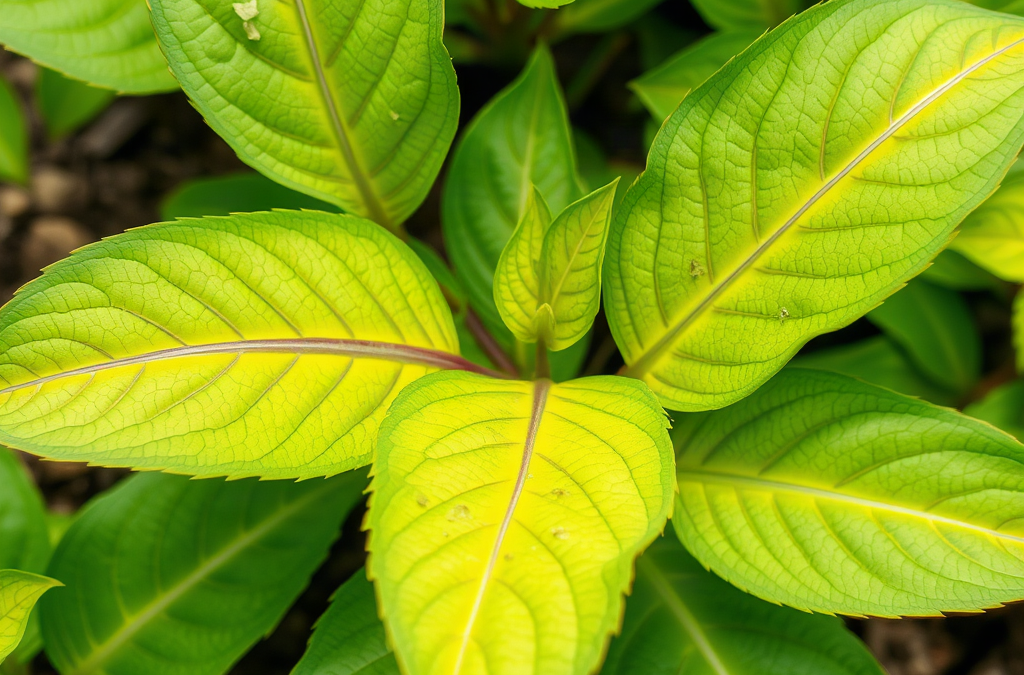
Recognize nutrient deficiency in plants by noting where symptoms begin, how they spread, and whether leaves show uniform yellowing, interveinal chlorosis, scorched margins, distorted growth, or unusual coloration. Symptoms appearing first on older leaves often involve mobile nutrients such as nitrogen, magnesium, or potassium, while damage beginning on new growth may point toward iron, calcium, or other less-mobile nutrients. Compare several plants and inspect roots, watering, soil pH, and pest damage before applying fertilizer. Confirm the pattern with a soil or growing-media test whenever possible, because excess moisture, compacted roots, and unsuitable pH can prevent nutrient uptake even when nutrients are present.
Read the Location and Pattern of Plant Symptoms
The location of the first affected leaves is often more informative than their color alone. Plants can move some nutrients from established tissue into developing shoots. When one of these mobile nutrients becomes scarce, the plant redirects its remaining supply toward new growth, and older leaves usually display symptoms first. Nitrogen, magnesium, potassium, and phosphorus deficiencies commonly follow this pattern, although the exact appearance varies by crop and growing conditions.
Other nutrients move poorly once deposited in plant tissue. A shortage is therefore more likely to appear in young leaves, shoot tips, blossoms, or newly forming fruit. Iron-related chlorosis typically affects new leaves, while calcium shortages may damage growing points or contribute to disorders in rapidly expanding fruit. Observing whether the oldest, newest, or middle leaves changed first immediately narrows the possibilities.
Next, examine the distribution of discoloration. Uniform pale green or yellow foliage differs from yellow tissue between veins, and both differ from brown leaf edges. Interveinal chlorosis leaves the veins greener than the surrounding tissue. Marginal scorch begins near the edges and may move inward. Necrotic spots represent dead tissue rather than simple loss of green color. Purple coloration can reflect nutrient stress in some plants, but it may also be a normal characteristic of the variety or a response to cold.
Consider how widely the symptoms occur. A nutritional or root-zone problem often affects several plants sharing the same bed, container mix, irrigation line, or fertilizer program. Damage restricted to one side of one plant is more consistent with root injury, stem damage, spray drift, sun exposure, or localized disease. A single yellow lower leaf on an otherwise vigorous plant may simply be aging naturally.
A useful field check records four details before any treatment:
- Leaf age: Did the problem begin on old leaves or new growth?
- Color pattern: Is yellowing uniform, between veins, at margins, or in spots?
- Plant distribution: Is one plant affected, or do several share the pattern?
- Progression: Is damage stable, or is it moving into additional leaves?
Photographing the same plant every few days makes progression easier to judge. Identification charts are useful only after these observations are recorded; matching a single yellow leaf to an online image can lead to an incorrect fertilizer application.
Match Leaf Changes to Likely Nutrient Problems
Different shortages produce overlapping symptoms, so nutrient identification works best as pattern matching rather than diagnosis by color. Nitrogen deficiency commonly causes older foliage to become generally pale, with reduced vigor and smaller growth. Because the yellowing is relatively uniform rather than sharply confined between veins, it can be distinguished from some magnesium symptoms. Nitrogen-starved leafy vegetables may remain undersized, but overwatering and root damage can create a remarkably similar appearance.
Magnesium deficiency usually begins on older leaves because magnesium is mobile within the plant. Tissue between the veins turns yellow while the veins remain greener, sometimes followed by reddish areas or dead patches. Potassium shortage also tends to start low on the plant, but it is more closely associated with yellowing or browning along leaf margins, weak stems, and poor development. Severe cases can look scorched around the perimeter.
Phosphorus deficiency may produce slow, compact growth and unusually dark green foliage. Some plants develop red or purple tones, particularly on older leaves. Cold soil can temporarily limit phosphorus uptake even if a laboratory test shows that the soil contains enough. Adding more phosphorus in that situation does not warm the root zone and may create a long-term excess.
Iron deficiency commonly appears as interveinal chlorosis on the youngest leaves. Advanced symptoms can turn new foliage almost cream-colored while veins retain some green. Iron may be present but chemically unavailable in alkaline soil or irrigation water. Manganese shortage can resemble iron chlorosis, making pH and laboratory analysis more dependable than visual comparison alone.
Calcium-related damage appears in growing tissue because calcium movement depends heavily on water flow through the plant. Distorted new leaves, dying shoot tips, blossom-end rot in tomatoes and peppers, or internal disorders in certain crops may be associated with inadequate calcium delivery. Yet blossom-end rot does not automatically mean the soil lacks calcium. Irregular watering, root injury, excessive salts, or rapid growth can interrupt calcium transport to fruit.
For anyone researching how to recognize the signs of nutrient deficiency, the strongest clue is a combination of leaf age, pattern, crop type, and root-zone conditions. No single symptom confirms a nutrient. A tomato with purple lower leaves in cold spring soil presents a different case from a mature tomato developing the same color during warm weather in an exhausted container mix.
Rule Out Conditions That Mimic Deficiency
Water, roots, temperature, and pH can produce deficiency-like symptoms even when fertilizer is adequate. Saturated soil displaces oxygen from pore spaces, impairing root respiration and nutrient uptake. The plant may yellow, wilt, or stop growing despite being surrounded by moisture and nutrients. Adding fertilizer to waterlogged ground increases salt exposure without repairing the oxygen shortage.
Check moisture below the surface rather than judging by appearance. Soil can look dry on top while remaining saturated around the roots. Conversely, potting mix may pull away from a container wall and allow irrigation to run through without wetting the root ball. If symptoms followed a period of heavy rain, blocked drainage, or frequent watering, root conditions deserve attention before nutrient products do.
Soil pH controls the chemical availability of many elements. In alkaline conditions, iron and certain micronutrients may become difficult for roots to obtain. Strongly acidic conditions can also restrict nutrient availability and increase the solubility of elements to undesirable levels. A foliar product may temporarily green affected leaves, but it does not correct the root-zone chemistry responsible for recurring chlorosis. Changing pH should be based on a test because large, rapid adjustments can harm roots and alter several nutrients at once.
Physical damage provides additional false signals. Root disturbance during transplanting can cause temporary yellowing. Compacted soil limits air, drainage, and root expansion. Herbicide drift may distort new leaves, while mites, sap-feeding insects, and leaf diseases can create stippling, mottling, or dead patches. Examine leaf undersides, stems, and roots rather than treating every discolored area as a fertilizer problem. Nutritional patterns are usually more symmetrical than chewing damage or isolated lesions, although exceptions occur.
Temperature matters as well. Cool soil slows biological activity and root function, while heat and drought restrict water movement. Seedlings set outdoors too early can display purple foliage or stalled growth that resolves as the soil warms. Containers exposed to intense sun can undergo repeated drying, concentrating fertilizer salts and burning leaf margins. That scorch can be mistaken for potassium deficiency.
The common failure mode is treating appearance without investigating timing. Ask what changed during the week or two before symptoms emerged: rainfall, irrigation frequency, repotting, a fertilizer dose, cold nights, root disturbance, or pest pressure. This history often reveals whether the plant faces a true shortage, an uptake problem, or direct injury. A broader approach to how to recognize the signs of nutrient deficiency therefore includes environmental evidence, not just leaf photographs.
Confirm the Cause and Correct It Safely
Testing is the safest bridge between visual clues and treatment. A soil test can report pH and available nutrient levels, helping distinguish an actual shortage from poor availability. For containers and raised beds filled with soilless media, request a test suited to that growing medium; ordinary mineral-soil recommendations may not translate directly. Water testing may also be useful when alkalinity or salt accumulation is suspected.
Collect a representative sample rather than scooping soil beside a fertilizer granule or compost pocket. Combine small portions from several locations at a consistent root-zone depth, following the laboratory’s instructions. Keep separately managed beds apart. Mixing samples from a heavily amended vegetable bed and an unfertilized border produces an average that accurately describes neither area.
Plant tissue analysis can provide additional evidence for valuable crops or persistent problems. Results are sensitive to plant species, growth stage, sampled leaf, and contamination, so use the laboratory’s sampling directions. Tissue testing describes what entered the plant, while soil testing describes the root environment; the two can answer different questions. Home test kits may offer a rough screening, but their limited precision makes them less suitable for diagnosing subtle micronutrient issues.
When evidence supports a deficiency, use a product that supplies the missing nutrient and follow its label rate. A complete fertilizer is not automatically the best choice. If a soil already contains ample phosphorus and potassium, applying all three major nutrients to correct nitrogen adds materials the plant does not need. Compost can improve soil structure and contribute nutrients gradually, but its composition varies and it is not a precise remedy for every acute deficiency.
Make one measured correction, water appropriately, and monitor new growth. Existing yellow or necrotic tissue may never become fully green again, so recovery should be judged by healthy emerging leaves, resumed growth, and the absence of spreading symptoms. Applying several products at once makes it difficult to determine which intervention worked and raises the risk of excessive salts or nutrient antagonism.
If a plant worsens after feeding, flush container media with suitable water when salt buildup is likely, provided drainage is good, and stop further fertilization while reassessing roots and moisture. Garden soil is less easily flushed, making restraint especially valuable. Repeated deficiencies in the same bed call for a longer-term correction involving pH, organic matter, drainage, and a crop-specific fertility plan rather than recurring emergency doses. That confirmation-and-monitoring sequence is the most reliable way to act on visible symptoms without creating a second problem.
Frequently Asked Questions
Can leaf color alone identify a nutrient deficiency?
No. Leaf color should be interpreted with leaf age, symptom pattern, crop type, soil moisture, pH, and recent growing conditions. Several nutrient, root, pest, and temperature problems produce similar discoloration.
Do nutrient deficiencies appear first on old or new leaves?
Mobile nutrient shortages often appear first on older leaves, while shortages of less-mobile nutrients tend to affect new growth. This distinction narrows the possibilities but does not confirm a diagnosis by itself.
Should I fertilize a plant as soon as its leaves turn yellow?
Not until you check moisture, drainage, roots, pests, and pH. Fertilizer will not correct waterlogged or damaged roots and may worsen salt stress.
Will deficient leaves turn green after treatment?
Mild chlorosis may improve, but severely yellowed or dead tissue often remains damaged. Judge recovery by healthy new growth and whether symptoms stop spreading.
What is the best test for suspected nutrient deficiency?
Begin with an appropriate soil or growing-media test that includes pH. Persistent, complex, or high-value crop problems may justify plant tissue or irrigation-water analysis as well.
Conclusion
Visible plant damage becomes more useful when treated as evidence rather than proof. Record whether symptoms started on old or new leaves, distinguish uniform yellowing from interveinal chlorosis or marginal scorch, and compare affected plants that share the same root environment. Then inspect moisture, drainage, roots, pests, temperature history, and pH before reaching for fertilizer.
A representative soil or growing-media test provides a sound basis for correction, especially when symptoms persist or involve micronutrients. Apply only the nutrient indicated, follow label rates, and avoid stacking multiple treatments. Watch emerging foliage rather than expecting damaged leaves to recover completely. If new growth remains healthy and discoloration stops advancing, the correction is probably working; continued decline means the original cause needs to be reconsidered.


