
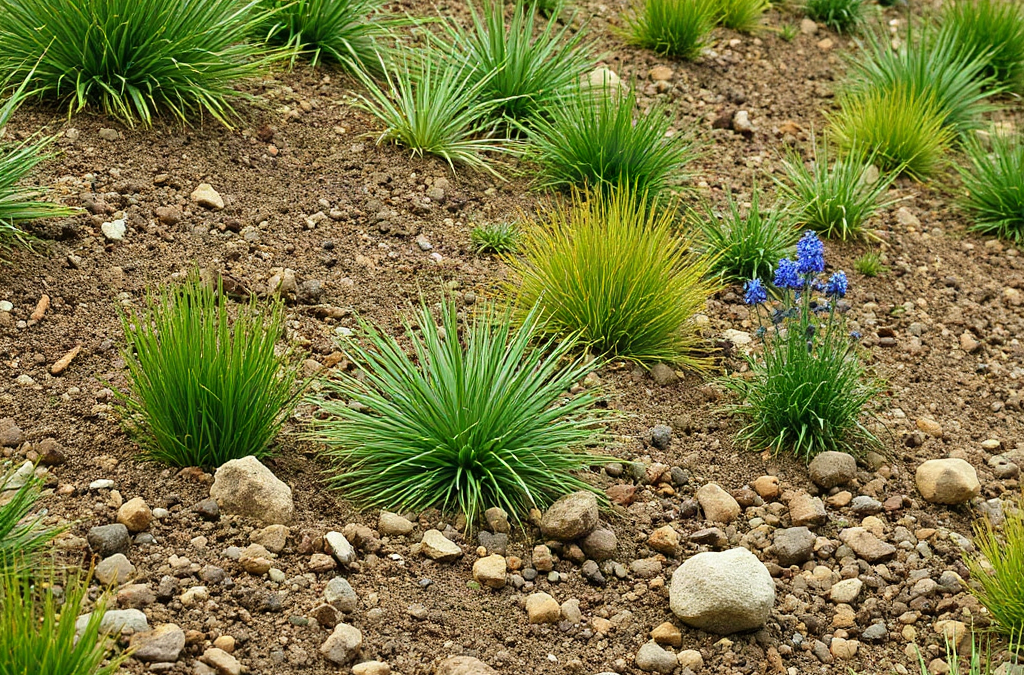
Plants for erosion control on sloping garden ground work best as a layered planting that combines fibrous-rooted grasses or sedges, spreading groundcovers, and deep-rooted shrubs suited to the site’s sunlight and moisture. Dense foliage intercepts rainfall, roots bind vulnerable topsoil, and stems slow runoff before it forms channels. Plant closely across the slope rather than in downhill rows, retain mulch with biodegradable netting where necessary, and divert concentrated water before planting. Avoid relying on one fast-spreading species: exposed gaps, unsuitable moisture conditions, and invasive growth can undermine long-term stabilization. Severe, actively moving slopes may require drainage or engineered support in addition to vegetation.
Assess the Slope Before Choosing Plants
A stable planting begins with identifying how water crosses the slope. Sheet flow spreads in a shallow film and can often be slowed by dense vegetation, while concentrated runoff cuts narrow channels that plants alone may not correct. Inspect the site during moderate rain if it is safe to do so, or look afterward for sediment fans, exposed roots, miniature gullies, and mulch collected at the bottom. These marks show where water is accelerating and where newly disturbed soil would be most vulnerable.
Slope steepness changes both plant choice and installation difficulty. A gentle bank that can be walked and watered safely offers many options, including ornamental grasses, low shrubs, and spreading perennials. A steep face is harder to prepare, mulch, irrigate, and weed without dislodging material. If the bank is visibly slumping, undermining a structure, or receiving discharge from a roof, driveway, or retaining-wall outlet, correct the drainage source and seek qualified site advice before treating planting as the solution.
Sun exposure and soil moisture should be assessed at several points rather than judged from the top of the bank. Upper slopes commonly dry faster because water drains away and wind exposure is greater. The toe may stay moist or even become waterlogged. A south- or west-facing bank can also heat rapidly, whereas a shaded slope beneath trees may be dry because established roots capture much of the available water. The same species rarely performs equally well across all these positions.
Check the soil by digging small test holes perpendicular to the surface. Note whether it is shallow over stone, compacted construction fill, loose sand, or cohesive clay. Roots stabilize soil only after they establish, so a plant that cannot penetrate the existing profile provides little protection. Avoid spreading a thick layer of rich topsoil over hard subsoil; the boundary can become a sliding plane when saturated. Incorporate only modest amendments into individual planting areas and preserve as much existing rooted vegetation as possible.
A practical slope assessment should answer four questions before plants are purchased:
- Where does water enter and leave? Redirect concentrated inflow to a suitable outlet rather than allowing it to scour planting pockets.
- Which areas dry first or remain wet? Divide the bank into moisture zones if conditions differ.
- Can the surface be reached safely? Maintenance access determines whether small plugs, larger containers, or professional installation is realistic.
- Is erosion superficial or structural? Vegetation can protect surface soil, but it does not replace retaining structures or drainage work on an unstable bank.
The common mistake is choosing attractive species before tracing runoff. Even vigorous plants may wash out when a downspout sends concentrated water through their root zones. Mapping the slope first makes Plants for erosion control on sloping garden ground part of a water-management plan rather than a cosmetic patch.
Match Root Systems and Growth Habits to the Site
Effective erosion planting uses several root forms because each controls soil differently. Fibrous-rooted grasses and sedges create a fine network near the surface, where rainfall and shallow runoff detach particles. Spreading perennials cover exposed spaces and reduce splash erosion. Shrubs anchor deeper layers and add stems that interrupt downhill water movement. Combining these forms generally leaves fewer functional gaps than planting a single groundcover across the entire bank.
Dense coverage matters, but rapid spread is not automatically desirable. Some aggressive plants escape garden boundaries, suppress neighboring vegetation, or become difficult to remove from drainage channels and natural areas. Before using a spreading species, check its status with a local extension service or invasive-plant authority. A locally appropriate native plant is not inherently suitable either; it must still tolerate the bank’s light, soil, moisture, and winter conditions.
Plant form should match the scale of the slope. Low, mat-forming perennials are useful between stepping stones, near paths, and on smaller banks where weeds can be reached. Clumping grasses and sedges provide stronger vertical structure on broader slopes but leave temporary openings while young. Shrubs cover more area per plant and can stabilize deeper soil, although their canopies may shade out understory plants unless the original spacing accounts for mature size.
Consider a sunny, dry bank with loose soil. A mixture of drought-adapted bunchgrasses, low spreading perennials, and scattered compact shrubs gives both near-surface reinforcement and deeper anchorage. On a damp shaded bank, woodland sedges, shade-tolerant creeping perennials, and moisture-compatible shrubs are more likely to close the surface. Substituting sun-loving turfgrass on the shaded site often produces thin growth, bare seams, and repeated reseeding rather than erosion control.
Evergreen foliage can protect soil during dormant months, but evergreen status should not outweigh site fit. Deciduous plants still retain root systems through winter, and standing stems can slow water. Likewise, turf is not always the simplest answer. Mown grass may hold a moderate slope once established, yet mowing steep ground is hazardous and repeated foot or machine traffic can compact soil. Unmown ornamental grasses or mixed low vegetation may require less disruptive maintenance.
Choose species by mature behavior, not their appearance in nursery containers. Confirm expected width, rooting habit, tolerance of periodic drought or saturation, and whether stems root where they touch the soil. The weak assumption is that deep roots alone solve erosion. Most initial loss occurs at the exposed surface, so deep-rooted shrubs need low plants or temporary surface protection between them. A layered community gives the slope protection at several depths and remains more resilient if one species performs poorly.
Select Plants for Sun, Shade, and Moisture
Plant names should be selected locally because climate, invasive status, and availability vary, but useful plant groups can be matched to recognizable slope conditions. For sunny, well-drained banks, consider regionally suitable bunchgrasses, creeping phlox, low-growing aromatic herbs where hardy, shrubby cinquefoil, or compact junipers that are not invasive locally. These choices tolerate leaner conditions once rooted, though they still require regular water during establishment.
Partly shaded slopes often support sedges, hardy geraniums, foamflower, lowbush blueberry where acidic conditions suit it, and compact woodland shrubs. Deep shade beneath mature trees is more restrictive. Pennsylvania sedge, wild ginger, Christmas fern, or other locally native woodland plants may be candidates in appropriate regions, but tree-root competition can make establishment slow. Adding irrigation briefly and deeply is usually more effective than repeatedly sprinkling the surface.
Moist lower slopes need plants that tolerate intermittent saturation without requiring permanently wet soil. Depending on region and available space, moisture-tolerant sedges, rushes, ferns, summersweet, red-twig dogwood, or inkberry may fit. Large shrubs should be kept away from paths, utilities, foundations, and narrow drainage features. A plant that thrives in moist soil can still fail where water stands continuously, so persistent pooling should be investigated before planting.
Use a simple three-layer selection plan rather than buying one species in bulk:
- Surface layer: Choose low plants that knit together and shield soil from raindrop impact.
- Reinforcement layer: Add clumping grasses, sedges, or robust perennials with dense fibrous roots.
- Anchor layer: Space shrubs where their deeper roots and woody stems can interrupt larger flows without crowding access.
For example, a partly sunny suburban bank might pair a matrix of sedges with flowering perennials and a few compact shrubs placed along broad contours. The sedges occupy most of the surface, flowers add seasonal diversity, and shrubs provide persistent structure. Planting only widely spaced shrubs would leave bare soil for several seasons; planting only a delicate flowering groundcover might not withstand runoff or weed pressure.
Local guidance is particularly valuable for Plants for erosion control on sloping garden ground because recommendations change across climates. University extension offices, native-plant societies, conservation districts, and government invasive-species lists can help narrow the palette. Use their suggestions as a screening tool, then confirm the plant’s mature size and exact site requirements.
Avoid assuming that a labeled “erosion-control mix” is automatically appropriate. Seed mixes may contain short-lived cover crops, species unsuited to garden maintenance, or plants that establish unevenly on compacted soil. Seed is economical for broad accessible banks, but plugs and container plants give more predictable placement. On a small residential slope, a mixed plug planting often offers better control over spacing and species than broadcasting seed into runoff-prone soil.
Plant and Maintain the Slope Without Releasing More Soil
Installation should disturb the smallest practical area at one time. Clear invasive weeds selectively instead of stripping the entire slope, and leave useful existing roots in place until replacement plants are ready. Work from stable access points, avoid wet soil, and do not repeatedly walk straight up and down the bank. Foot traffic creates compacted tracks that can become runoff channels.
Set plants in staggered rows that roughly follow the contour. A triangular arrangement breaks up direct downhill pathways better than aligned vertical rows. Dig each hole into the slope so the root ball sits upright at its original growing depth; do not leave the root flare buried or create a smooth basin that funnels overflow downhill. Firm the backfill enough to remove large voids without compressing it into a hard plug.
Spacing should reflect mature width while recognizing that erosion control needs early coverage. Using smaller plants at moderately close spacing often closes gaps faster than scattering a few large specimens. Temporary protection can bridge the establishment period. A thin layer of coarse wood chips or shredded mulch reduces splash, but loose mulch may slide. Biodegradable erosion-control blanket, coir netting, or fiber rolls can hold the surface where properly selected and securely installed. Avoid plastic mesh that can persist, snag wildlife, or interfere with maintenance.
Water slowly so it infiltrates instead of running down the face. Dripline secured across contours or individual low-flow emitters usually disturb less soil than overhead watering. Check the lowest emitters because gravity and pressure differences may cause uneven delivery. Newly installed drought-tolerant plants are not drought-proof; their original root balls can dry out before roots enter surrounding soil.
Signs of progress include new shoots, roots beginning to occupy adjacent soil, mulch remaining in place after rain, and runoff leaving without visible sediment. Warning signs include exposed root balls, rills forming between rows, yellowing plants in wet pockets, wilting at the crest, and water bypassing emitters. Repair small channels promptly with appropriate surface protection and vegetation rather than filling them repeatedly with loose soil.
Weed control remains necessary until the intended planting closes. Hand removal is less disruptive when weeds are young, while repeated hoeing can loosen the very surface being protected. Replace dead plants during a suitable planting season and adjust the species if losses occur in the same moisture zone. The common failure is treating installation as the finish line. A slope typically needs focused watering, gap repair, and runoff checks through its establishment period before the planting can carry most of the protective work.
Frequently Asked Questions
What type of root system is best for erosion control?
Fibrous roots are especially useful near the surface, while deeper shrub roots reinforce lower layers. A combination of grasses or sedges, spreading perennials, and shrubs usually protects more of the soil profile than one root type.
Can groundcover plants stop erosion on a steep slope?
Groundcovers can reduce surface erosion after they fill in, but they may not correct gullies, concentrated drainage, or structural movement. Steep or unstable slopes may also require erosion matting, drainage changes, or professional stabilization.
Should plants be arranged in rows across a slope?
Staggered rows following the contour are preferable to straight downhill lines. This layout interrupts runoff paths and avoids creating open channels between plants.
Is mulch enough to protect a newly planted bank?
Mulch reduces raindrop impact but can wash or slide away. On vulnerable banks, combine a thin mulch layer with securely installed biodegradable netting or another suitable erosion-control material.
How can I tell whether the planting is controlling erosion?
Look for expanding foliage, rooted growth between plants, stable mulch, and runoff without visible sediment. New rills, exposed roots, leaning plants, or soil accumulating at the slope’s base indicate continuing problems.
Conclusion
A durable slope planting begins with runoff observation, not a shopping list. Correct concentrated water, separate the bank into sun and moisture zones, and retain existing roots wherever practical. Build coverage with complementary plant forms: low spreaders protect the surface, grasses or sedges reinforce shallow soil, and shrubs add deeper structure. Install them in staggered contour rows while limiting disturbance and protecting open soil during establishment.
After planting, inspect the bank following rain rather than waiting for plant decline. Small rills, displaced mulch, and repeatedly dry or saturated pockets reveal problems while they are still manageable. Replace failures with species better matched to that exact position, and seek site-specific help when the slope is moving, undermining structures, or receiving concentrated drainage. Vegetation works best as living surface protection within a sound water-management plan.


