
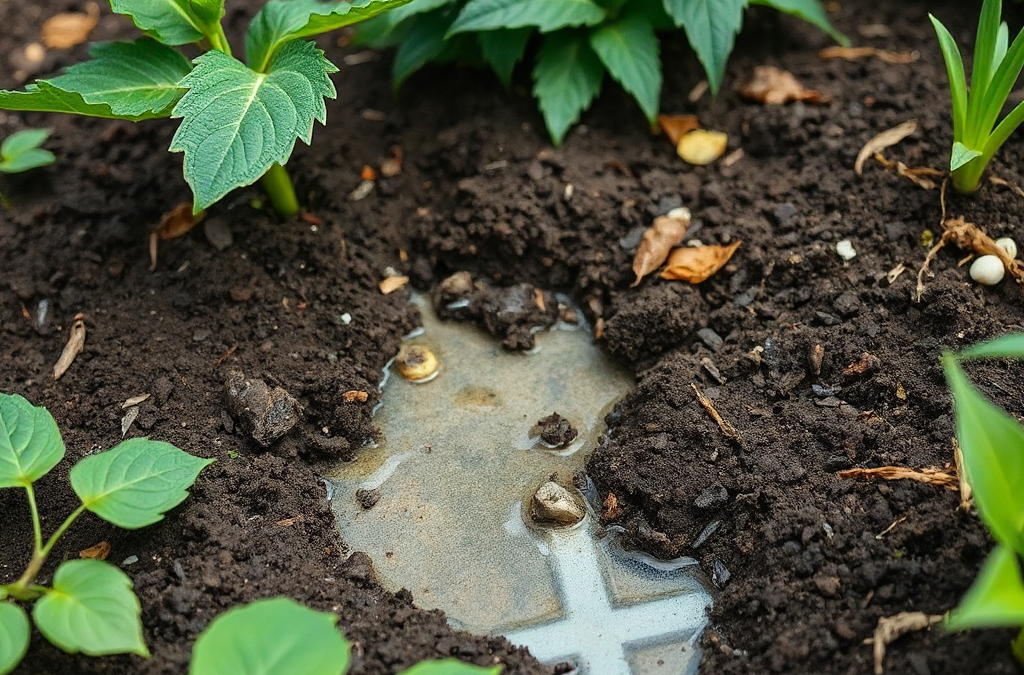
Signs your garden needs better drainage include puddles that remain after rain, yellowing or wilting plants in wet soil, foul odors, algae or moss, and roots that turn brown or mushy. These symptoms usually mean water is moving too slowly through compacted soil, a low planting area, or a blocked outlet, leaving roots short of oxygen and increasing the risk of rot. Test the site after a moderate rainfall, dig a small inspection hole, and check whether water drains within a reasonable period rather than adding amendments immediately. Improve the underlying flow with compost where appropriate, raised beds, a graded outlet, or a properly designed drain; avoid relying on gravel alone in a poorly draining planting hole.
Visible Symptoms Of Poor Garden Drainage
Standing water is the clearest warning, but it is not the only one. A garden may have a drainage problem when puddles remain for hours or days after ordinary rain, soil feels slick below the surface, or plants wilt even though the bed is visibly wet. Roots need air spaces as well as moisture. When water fills those spaces for too long, roots struggle to function and plants can show symptoms that resemble drought.
Look for patterns rather than a single unhappy plant. Lower leaves may turn pale or yellow, growth may remain stunted, and stems can soften near the soil line. Digging around a declining plant may reveal brown, gray, or mushy roots instead of firm, light-colored ones. A sour or stagnant smell suggests slow-moving water and decomposing organic material. Green algae, moss, and repeated fungal problems on the soil surface can reinforce the diagnosis, although none of these signs proves that drainage is the only cause.
Site clues often explain why symptoms appear in one part of a bed. Water may collect at the bottom of a slope, beside a roof downspout, beneath a dripping hose connection, or along a compacted path. A planting area can also remain wet where a hard layer blocks downward movement. Compare a struggling patch with a nearby area containing similar plants. If the plants fail in the lowest section while the higher ground performs normally, water movement deserves attention before fertilizer or pesticide.
- Persistent puddles after the surface has dried elsewhere.
- Plant decline concentrated in a low spot or bed edge.
- Mushy roots, soft crowns, or a sour soil odor.
- Crusted, compacted soil that sheds rain instead of absorbing it.
A common mistake is treating yellow leaves as proof of nutrient deficiency. Adding fertilizer to saturated soil can intensify stress without restoring oxygen to the root zone. Use the symptoms as a reason to inspect water movement, not as a cue to apply a product.
Why Water Stays In The Root Zone
Poor drainage usually results from a mismatch between incoming water and the soil’s ability to transmit it away. Heavy clay contains very small pores that can hold water tightly and drain slowly. Compaction removes larger air channels, while a shallow hardpan or dense subsoil can act like a basin beneath looser topsoil. A low site may receive runoff from surrounding ground, so even reasonably healthy soil can become saturated during wet weather.
Texture and structure are different considerations. Clay soil may drain better when it has stable aggregates and organic matter, while a heavily trafficked loam can drain poorly after its pores collapse. Conversely, adding a thin layer of compost to the surface may improve infiltration over time but will not necessarily correct a deep restrictive layer. Mixing a small amount of sand into clay is another widely repeated shortcut; without the right proportion and thorough incorporation, it may create a dense, concrete-like mixture rather than an open soil structure.
Water can also arrive from built features. A downspout discharging beside a vegetable bed, an impermeable patio draining toward a border, or an irrigation zone running longer than the soil can absorb may create localized saturation. In a container, blocked holes or a saucer that holds runoff can produce the same root-zone problem on a smaller scale. Check the source and direction of water before reshaping the bed.
Plants differ in their tolerance. A moisture-loving plant may survive in a damp hollow, while herbs, many Mediterranean plants, and crops such as onions may decline there. Choosing a wet-site plant can be a sensible design response when the condition is stable and the location is safe. It is not a substitute for drainage where water threatens foundations, paths, structures, or edible crops that require a drier root zone.
The failure mode to avoid is confusing surface dryness with complete drainage. A crusted surface may look dry while water remains trapped below. Conversely, a shallow puddle after an intense storm may be normal if it disappears promptly. Duration, location, soil depth, and plant response provide a more reliable picture than one glance at the bed.
Testing Drainage Before Choosing A Fix
A simple observation and infiltration test can prevent expensive, poorly matched repairs. Watch the area during and after a moderate rain, noting where water enters, where it collects, and how long it remains. Avoid judging the site immediately after an unusually severe storm because even well-drained ground may temporarily pond. Repeat the observation during another wet period if the pattern is unclear.
For a basic soil test, dig a hole roughly the depth of a plant’s root zone and fill it with water once to wet the surrounding soil. Refill it and observe how quickly the water level falls. The exact time is less useful than comparing the problem area with a nearby productive area under similar weather. If the hole remains full for a prolonged period, investigate compaction or a restrictive layer. If water disappears quickly from the hole but puddles still form, surface grading or incoming runoff may be the main issue.
Inspect the soil at several depths. A loose upper layer over dense subsoil can allow water to disappear from the surface but remain perched above the barrier. A narrow probe, shovel, or soil knife may reveal where resistance changes sharply. Check irrigation emitters, hose timers, downspouts, and nearby paving at the same time. Drainage problems often come from a combination of compacted soil and excess water rather than one isolated defect.
Use this short priority sequence:
- Identify whether the water comes from rainfall, irrigation, runoff, or a blocked outlet.
- Map the wettest locations and compare them with plant damage.
- Check soil texture, compaction, and depth to any dense layer.
- Choose the least disruptive correction that moves water safely away.
Do not dig a drain without considering its destination. Sending water toward a neighboring property, foundation, septic area, or public walkway can create a larger problem. For substantial grading, buried drainage, or persistent water near structures, local drainage requirements and qualified site advice may be appropriate. The best test is not merely whether water leaves one hole; it is whether the whole area receives enough oxygen without creating a new wet spot downstream.
Practical Drainage Improvements And Their Limits
The right correction depends on the mechanism. If irrigation is excessive, shorten run times, repair leaks, and allow the bed to dry to the crop’s appropriate level between watering. If a downspout is saturating one corner, redirecting its discharge to a suitable location may solve the problem more effectively than rebuilding soil. If foot traffic has compacted an empty bed, loosening the soil when it is neither saturated nor dusty and adding mature organic matter can rebuild structure gradually.
Raised beds are useful where the surrounding ground stays wet but a permanent change to site grade is impractical. They provide additional well-drained root-zone depth, especially when filled with a balanced soil blend rather than a layer of coarse material beneath fine soil. However, raised beds do not stop water entering from a high water table or runoff. Their sides may also dry faster, requiring more careful irrigation during hot weather.
Surface grading can move shallow runoff away from planting areas, while a swale or planted rain garden can manage water where space allows. These options slow and spread runoff instead of simply exporting it. A French drain or similar perforated-pipe system may be suitable for a persistent subsurface flow, but its performance depends on correct slope, filter materials, outlet, and maintenance. A buried pipe with no functioning discharge point is not a drainage system.
Organic matter is valuable, but it is not a universal cure. Compost can improve aggregation in some soils and increase biological activity, yet repeated additions cannot overcome a blocked outlet or a high seasonal water table. Gravel placed in the bottom of a planting hole is often assumed to create drainage; when fine soil sits above it, water may remain perched at the boundary instead. Use an open drainage design only when the entire system, including its exit, has been considered.
Signs that an improvement is working include shorter ponding duration, firmer new growth, healthier roots, and fewer wet-zone symptoms after comparable rain. Failure shows up as the same low spot filling again, water backing up at the outlet, or plants declining despite surface changes. Link observations to the relevant signs your garden needs better drainage rather than judging success by a freshly disturbed surface.
Prioritize safe water movement first, soil structure second, and plant selection third. A moisture-tolerant planting can complement a stable wet area, while a raised bed or engineered outlet is more appropriate when the goal is to grow plants that cannot tolerate saturation. Keep notes after rainfall so the next adjustment responds to evidence instead of guesswork; the same signs your garden needs better drainage can have different causes in clay, containers, and sloping yards.
Frequently Asked Questions
How long should water remain in a garden bed after rain?
A brief puddle after heavy rain may be normal, but water that remains for an extended period or repeatedly returns in the same location warrants a drainage inspection.
Can compost fix a garden with poor drainage?
Compost may improve structure in compacted soil over time, but it will not correct a blocked outlet, deep hardpan, high water table, or runoff entering from another area.
Does adding gravel to a planting hole improve drainage?
Usually not when fine soil sits above the gravel. Water can collect at that boundary, so a complete drainage route is more useful than a gravel pocket.
Are yellow leaves always a drainage symptom?
No. Yellowing can result from nutrients, pests, disease, or normal aging. A wet root zone becomes more likely when yellowing occurs with puddling, soft roots, or foul-smelling soil.
When is a raised bed a sensible solution?
A raised bed suits a persistently wet site when the surrounding water can move away safely and the added soil provides genuine root-zone depth. It is less effective against a high water table or active subsurface flow.
Conclusion
Persistent puddles, wet-season plant decline, soft roots, algae, and sour-smelling soil are useful clues that water is not leaving the root zone as it should. Confirm the pattern by observing the site after rain, checking soil at more than one depth, and tracing irrigation or runoff to its source. Reduce excess water before adding amendments, and avoid quick fixes such as a gravel layer that has no outlet. Raised beds, improved soil structure, grading, swales, or a properly designed drain each suit different conditions. Judge the repair by shorter ponding, stronger new growth, and healthier roots over time. If water threatens structures or cannot be directed safely, seek site-specific drainage advice rather than shifting the problem elsewhere.
Further Reading
Authoritative Sources
- CDC Nutrition
cdc.govOfficial public-health nutrition guidance and data.
- USDA FoodData Central
fdc.nal.usda.govOfficial food composition and nutrient data.
- MedlinePlus Health Information
medlineplus.govConsumer health information from the U.S. National Library of Medicine.
- NIH Office of Dietary Supplements
ods.od.nih.govEvidence-based fact sheets about vitamins, minerals, supplements, and nutrition.


