
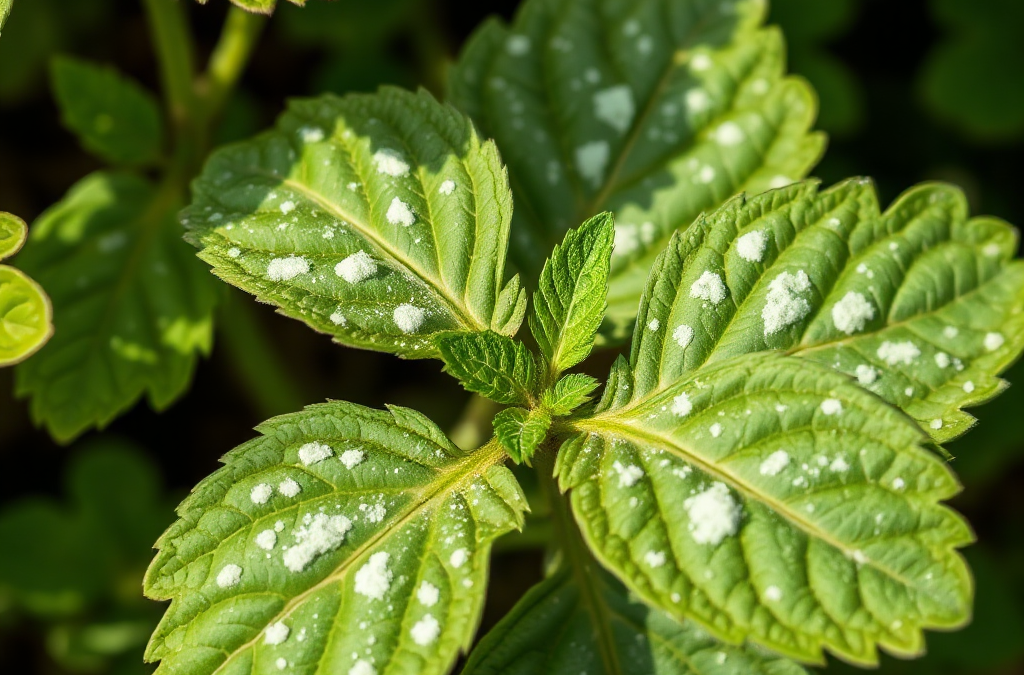
Treat powdery mildew on vegetables by removing heavily infected leaves, improving air movement, keeping foliage dry overnight, and applying a labeled fungicide or suitable garden treatment early in the infection. The white coating develops when powdery mildew fungi spread across leaf surfaces, often during warm, dry weather with humid nights and crowded growth. Prune selectively rather than stripping a plant bare, sanitize tools, and avoid composting diseased material unless your compost system reaches reliable high temperatures. Neem oil, potassium bicarbonate, sulfur, or horticultural oils may help on some crops, but product labels, weather conditions, and harvest intervals determine safe use. Reapply only as directed and monitor new growth for fresh patches.
Confirm Powdery Mildew Before Treating
Powdery mildew usually appears as white, flour-like patches on the upper surfaces of leaves, stems, or young growth. Unlike many leaf diseases, the fungus often grows across the surface rather than requiring prolonged leaf wetness. Squash, cucumbers, melons, peas, beans, and some tomato varieties are frequent hosts, although the exact fungal species may differ from crop to crop. Early patches can look harmless, but expanding colonies reduce the green leaf area available for photosynthesis and may distort tender growth.
Check the pattern before reaching for a spray. Powdery mildew commonly begins as scattered circular spots that merge into a dusty coating. Leaves may yellow, curl, or become brittle as the infection advances. Downy mildew, by contrast, often produces angular yellow areas bounded by veins and may show gray or purplish growth on the underside in humid conditions. Insect residue, dried soil, and spray deposits can also look white, so gently wiping a patch and inspecting nearby leaves can prevent an unnecessary treatment.
Severity should determine the response. A few small spots on an otherwise vigorous zucchini plant call for prompt sanitation and a protectant treatment, while leaves covered from edge to edge are unlikely to regain normal function. Removing every affected leaf may create more stress than it relieves, particularly on a young cucumber or melon. A useful rule is to remove leaves that are badly coated, yellowing, or touching healthy foliage, while preserving enough sound leaves to support fruit development.
Do not assume that mildew came from watering the leaves alone. Spores can arrive on air currents, clothing, tools, plant debris, or nursery plants. Warm days, humid nights, shade, dense canopies, and susceptible varieties can let the disease establish even when irrigation is carefully managed. Correct identification matters because a treatment intended for insects or a bacterial disease will not address a fungal colony.
Remove Infection and Correct Garden Conditions
Physical sanitation is the fastest first move when visible mildew is limited. Clip affected leaves with clean pruners, place them in a bag, and remove them from the growing area. Disinfect the cutting surfaces between heavily diseased plants, especially when moving from one crop to another. Do not rub infected foliage against neighboring plants while pruning; spores can be dislodged easily. The removal step will not eliminate airborne spores, but it reduces the amount of active growth that treatments must manage.
Airflow is the most useful environmental correction in a crowded planting. Powdery mildew can thrive when leaves remain surrounded by humid, still air, even if the general weather feels dry. Thin overlapping leaves, tie sprawling vines to a trellis where appropriate, and avoid placing new plants so close that mature foliage forms a continuous wall. A cucumber trained vertically may dry faster than one resting on damp ground, but trellising cannot compensate for severe crowding or a shaded site.
Water the root zone in the morning rather than sprinkling foliage late in the day. Morning irrigation gives incidental moisture time to evaporate and reduces the humid period around the plant at night. It does not make overhead watering a guaranteed cause of powdery mildew, and it will not wash away an established infection. The priority is consistent root moisture without repeated wet-dry stress, because stressed plants may produce weaker new growth and become harder to manage.
Fertilizer deserves restraint. Excess nitrogen can encourage a flush of soft, dense foliage that closes the canopy and creates more surfaces for infection. Cutting fertilizer entirely can also weaken a fruiting crop. Compare the plant’s growth with its soil test, crop stage, and label recommendations rather than adding a quick dose whenever leaves look pale. Remove weeds near the crop, improve light where feasible, and avoid handling plants while foliage is wet. These measures reduce favorable conditions, but they are not substitutes for treating active colonies.
A practical sanitation priority list is:
- Remove the worst leaves first and bag them.
- Open dense growth without exposing the plant to sudden severe pruning.
- Water at the soil line in the morning.
- Inspect neighboring plants, especially cucurbits and peas.
- Pause unnecessary nitrogen feeding until growth is evaluated.
For broader crop-care decisions, connect this work with how to treat powdery mildew on vegetables when planning pruning, watering, and harvest routines together rather than treating the disease as an isolated spray problem.
Choose Treatments That Fit the Crop
Fungicidal treatments work best as protectants or early interventions; they generally do not restore leaves that are already heavily coated. Begin by reading the product label for the specific vegetable, application rate, protective equipment, re-entry instructions, and harvest interval. A product that is acceptable for ornamental plants may not be labeled for edible crops. The label is also where compatibility warnings, temperature limits, and instructions about repeated applications are provided.
Several treatment types may be useful in the right circumstances. Potassium bicarbonate products can alter the leaf surface in a way that is unfavorable to mildew, while sulfur products may protect susceptible foliage when applied according to label directions. Horticultural oils and some biological fungicides are used for early infections. Homemade mixtures are less predictable: strong soap, concentrated vinegar, or undiluted oils can burn leaves and damage blossoms. Baking soda mixtures may also perform inconsistently if concentration, coverage, and plant sensitivity are not controlled.
Test any unfamiliar product on a small area first and wait before treating the whole crop. Heat, drought stress, tender new growth, and combinations of products can increase the risk of phytotoxicity. Oils and sulfur should not be used close together unless the label specifically permits that sequence; the combination can injure foliage. Avoid spraying during intense heat or on plants already wilting. Good coverage of both sides of accessible leaves matters, but soaking the plant repeatedly is not automatically better.
Choose the least disruptive effective option that matches the situation. A gardener with two infected squash leaves may reasonably favor pruning and a labeled low-impact product, while a large planting with repeated infections may need a planned rotation of labeled fungicide groups to reduce selection for resistance. Organic approval does not mean harmless, and a synthetic product is not automatically inappropriate when used legally and carefully. Crop safety, pollinator exposure, harvest timing, and disease pressure should guide the decision.
Reapply only at the interval on the label. Spraying every day can waste product, increase residue and leaf injury, and still fail if dense foliage prevents coverage. The goal is not to make old white patches disappear instantly. A treatment is showing value when new leaves remain clean or develop fewer lesions while the plant continues producing healthy growth. If fresh patches expand after properly timed applications, reassess diagnosis, coverage, weather, and whether the crop is too severely infected to justify continued treatment.
Use how to treat powdery mildew on vegetables as a crop-specific reference point before applying any spray to harvested produce, because edible-crop labels and waiting periods vary considerably.
Prevent New Infections and Judge Results
Prevention begins with the next planting, not only with the current outbreak. Select resistant or tolerant varieties when seed catalogs identify those traits, but treat resistance as reduced risk rather than immunity. Disease pressure can overwhelm a tolerant variety in a crowded, poorly lit bed. Give plants their mature spacing, position susceptible crops where they receive suitable sunlight, and use trellises for vining crops when the structure can support the plant without creating a dense canopy.
Inspect plants at least weekly during warm periods, looking closely at young leaves and the lower canopy. Early detection changes the economics of treatment: removing a few infected leaves is simpler than trying to protect a plant whose foliage is already covered. Check adjacent plants as well, since a clean-looking cucumber beside a heavily infected squash plant may already carry early colonies that are difficult to see.
Crop rotation can reduce some disease carryover, but it is not a complete answer because powdery mildew spores travel through air and many related crops can host different species. Rotate crops for broader soil and pest-management reasons, remove exhausted vines promptly, and clear diseased debris rather than leaving it beneath the next planting. Do not save seed from severely diseased plants when reliable clean seed is available, particularly if the crop is one where seedborne disease is a concern.
Keep a simple treatment record with the crop, first symptoms, weather, product, date, and plant response. That record helps distinguish a failed product from a late application or poor coverage. For instance, if new growth stays clean for a week but becomes infected after a humid spell, the treatment may have provided protection that was overtaken by new disease pressure. If every leaf burns after spraying, stop and identify the product, temperature, concentration, and tank-mix issue before applying anything else.
Expect management rather than instant recovery. Older damaged leaves may remain marked even when the disease is no longer advancing, so judge success by the condition of new growth, continued flowering, and the plant’s ability to maintain useful foliage. If a plant is declining, fruit quality is poor, and most leaves are infected, removing it can protect nearby crops and free space for a healthy replacement. Continuing repeated sprays on a failing plant may expose the gardener and environment without producing a worthwhile harvest.
Frequently Asked Questions
Can powdery mildew kill a vegetable plant?
Light infections may have little effect, but severe or repeated infections can reduce photosynthesis, weaken growth, and lower yield. Young plants and heavily affected crops are at greater risk.
Should infected leaves be removed?
Remove leaves that are heavily coated, yellowing, or touching healthy foliage. Keep enough healthy leaves for the plant to support fruit, and discard infected material away from the bed.
Does milk cure powdery mildew?
Milk sprays have shown variable results and should not be treated as a guaranteed cure. If used, follow a reliable horticultural recommendation and avoid spraying in conditions that may scorch foliage.
Can powdery mildew spread through garden soil?
The disease is primarily spread by airborne spores, although infected debris and tools can contribute to carryover. Removing debris and cleaning tools still reduces avoidable spread.
Is it safe to eat vegetables from an infected plant?
Powdery mildew usually affects foliage rather than making the vegetable itself poisonous, but harvest only according to the product label if a treatment was applied. Discard produce that is damaged, contaminated, or otherwise questionable.
Conclusion
Effective mildew management combines early recognition with several modest corrections. Remove the most damaged foliage, open crowded growth, water at the soil line in the morning, and inspect nearby plants before the coating spreads. Use only a product labeled for the specific edible crop, test it on a small area, and follow its rate, weather limits, and harvest interval. Do not judge success by whether old leaves look perfect; watch whether new growth stays clean and the plant continues to produce. Resistant varieties, proper spacing, good light, clean-up at season’s end, and weekly inspections make future outbreaks easier to contain. When a plant is mostly infected and declining, removal may be more responsible than repeated spraying.


